Why Vinyl Fencing Sags and Warps in Ocala’s Sandy Soil and Humidity
If your vinyl fencing sags or warps within a few years of installation, the fence material is usually not the problem. In Ocala, the real causes sit below the ground and above it: sandy soil that lets posts shift, and summer heat and humidity that make PVC expand and move. This guide walks through how to diagnose the problem step by step, so you know what you are looking at before anyone sells you a fix. Understanding vinyl fence sagging diagnosis is essential for homeowners dealing with these issues.
This matters more if you live in a deed-restricted community. A leaning vinyl fence is one of the first things an HOA notices on a drive-through. According to Forbes, fencing is a factor in 23% of HOA violation notices, tied with design changes as the second most common issue behind landscaping. Diagnosing a sag early can mean a small repair instead of a violation letter and a forced replacement.
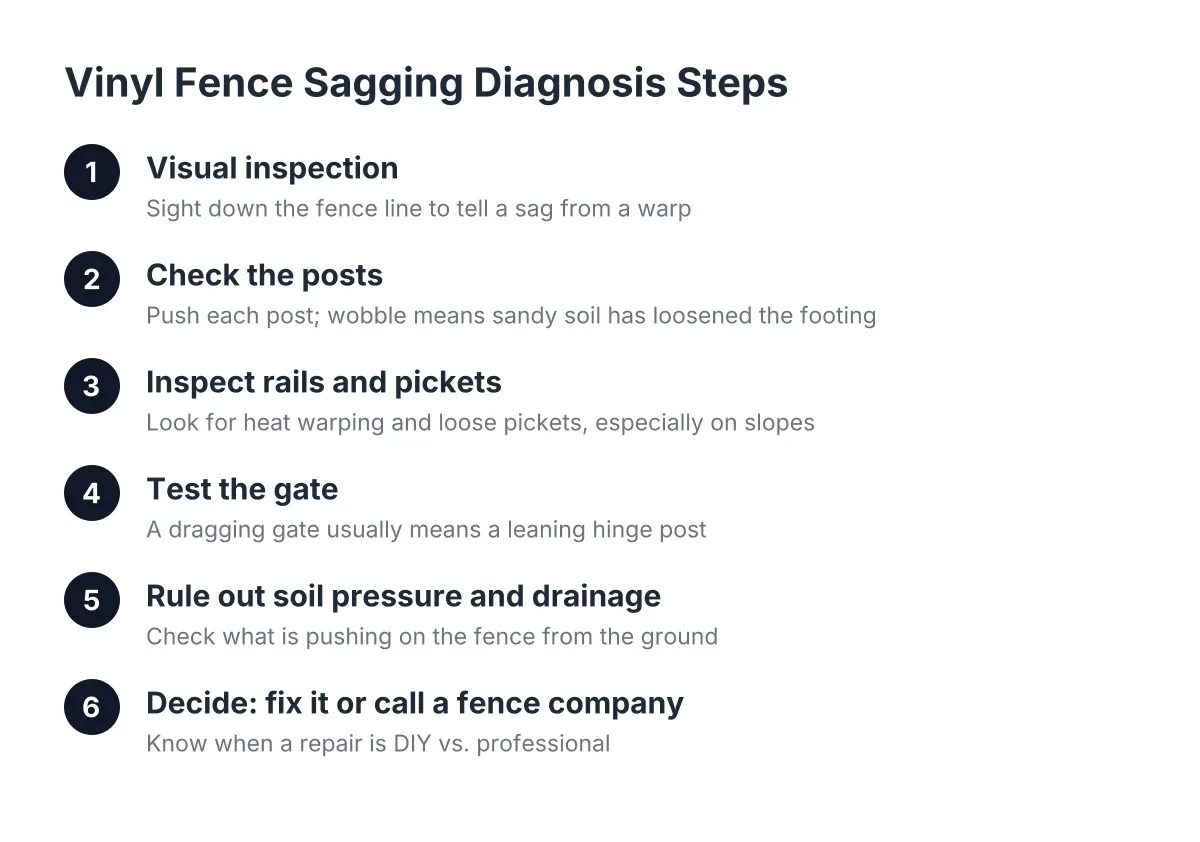
Step 1: Visual Inspection and Understanding Vinyl Fence Sagging Diagnosis
Start by naming the problem correctly, because the two have different causes. A sag means the fence has dropped or leaned, and that almost always traces back to the posts and the soil. A warp means the vinyl itself has bowed, rippled, or twisted, and that usually traces back to heat, sun exposure, or an installation detail.
Walk the fence line and sight down it from one end, the way you would check a board for straightness. Note where the line breaks. Does the whole panel lean together, posts included? That is a sag. Do the posts stand straight while a rail bellies downward or a panel ripples between them? That is a warp.
Take photos from the same spot every few weeks. In an HOA community, dated photos also help you show the architectural review board that you caught the issue and are addressing it, which goes a long way when a violation letter is in play.
Step 2: Check the Posts, Because Ocala's Sandy Soil Moves
Posts are the foundation of a vinyl fence. The panels only stay straight if the posts stay put, and in Ocala's sandy, shifting soil, posts move more than most homeowners expect. Grab each post near the problem area and push on it. Any wobble at ground level means the footing has lost its grip.
Here is why this happens locally. Sand drains fast, which is good for puddles but bad for post stability. Heavy seasonal rain washes fine material away from around the footing, and over a few wet summers the concrete collar can loosen like a tooth in a socket. The post tilts, the panel follows, and from the street the whole run looks like it is sagging. Proper vinyl fence sagging diagnosis requires checking whether soil movement is causing the posts to shift and lose their structural integrity.
Look for these signs at each post:
- A visible gap between the concrete collar and the surrounding soil
- Soil washed out or mounded on one side after heavy rain
- A post that leans in the same direction as the panel sag
- Cracked or crumbling concrete at grade
If the posts check out solid and plumb, move on. If they wobble, you have found your sag, and no amount of panel adjustment will fix it until the footing is reset deeper with proper drainage in mind.
Step 3: Inspect the Rails and Pickets for Heat Warping
Next, look at the horizontal rails. In Florida sun, vinyl expands when hot and contracts when cool, and it does this every single day. Rails that were cut too long and jammed tight between posts have nowhere to go when they expand, so they bow. Rails cut to fit snugly with room to move stay straight. Run your hand along the bottom rail on the sunniest stretch of fence; that is where warping shows first.
Check the pickets too. On a vinyl picket fence or privacy panel, pickets that were not fully seated in the rail channel during fence installation can creep loose as the vinyl cycles through heat and humidity. On sloped sections this gets worse, because pickets tend to slide downhill if the panel was built in the wrong direction for the grade. A rippled or uneven picket line on a slope points to an install shortcut, not a material defect.
Dark objects against the fence make heat warping worse. A black trash bin, a grill, or reflective low-E windows across the yard can concentrate heat on one section and bow it while the rest of the run stays straight. If only one panel warps and it faces a heat source, you have likely found the cause.
Step 4: Test the Gate, the First Place Vinyl Fencing Sags and Warps
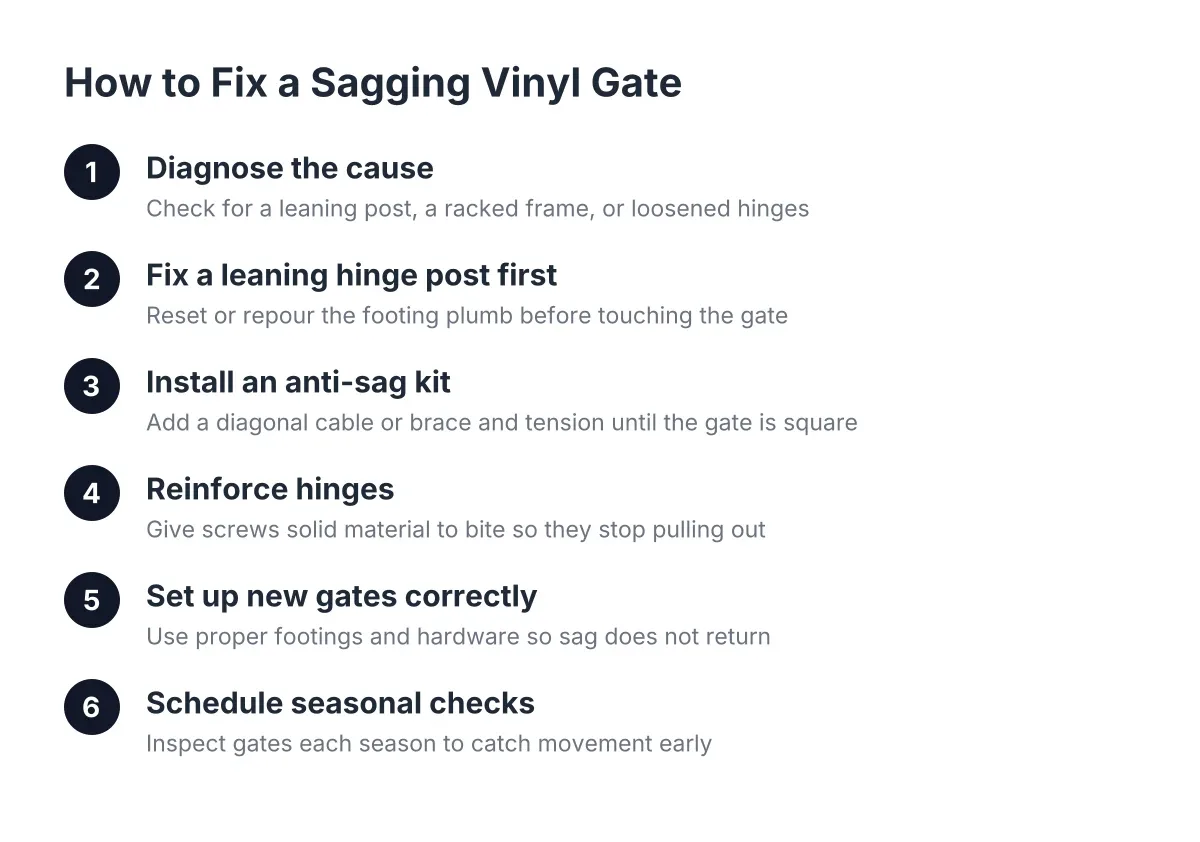
A fence gate fails before the fence does. It carries its own weight on hinges, gets opened hundreds of times a year, and hangs from the two posts that take the most stress. Open the gate and let go. Does it swing on its own or drag? Does the latch still line up? A gate that drags in Ocala is usually a leaning hinge post, not a bad gate.
Here is a hypothetical that plays out across newer Ocala developments. Say a homeowner in a gated community installs a vinyl privacy fence with a standard gate, and the hinge post gets set in sandy fill with a shallow footing. Two rainy seasons later the post leans an inch, the gate drags, and the latch misses. The HOA sends a courtesy notice about the gate hanging open. The fix is not a new gate; it is resetting or reinforcing that one post.
For gates and other high-stress spots, installers can run a metal pipe inside the vinyl post as reinforcement, with the vinyl sleeved over it. The fence still looks like clean white vinyl from the street, which keeps the HOA happy, but the post carrying the gate has steel doing the structural work. If your gate post moves at all, ask whether it was reinforced. Many are not.
Step 5: Rule Out Soil Pressure and Drainage Problems
Now look at what is pushing on the fence. Vinyl panels are not retaining walls. If one side of the fence line sits higher than the other, or if a flower bed was built up against the bottom rail, that dirt pressure will bow panels outward over time. Clear soil and mulch away from the bottom rail so the vinyl is not carrying a load it was never designed for.
Drainage matters just as much. Watch where water runs during a summer storm. Water that channels along the fence line undermines footings one rain at a time. A downspout aimed at a fence post is a slow-motion sag. Redirecting that water is often the cheapest fix on this whole list.
Step 6: Decide What You Can Fix and When to Call a Fence Company
Sort your findings into two buckets. Some problems are homeowner-level fixes; others need fence repair with equipment and experience. One honest trade-off to know upfront: resetting a post in vinyl fencing means disassembling panels, breaking out old concrete, and re-plumbing in soil that wants to shift, so a repair that looks simple from the street can be the hardest part of the job.
You can likely handle these yourself:
- Reseating a picket that has crept out of its rail channel
- Clearing soil, mulch, or landscaping pressing on the bottom rail
- Redirecting downspouts and fixing drainage along the fence line
- Minor gate latch and hinge adjustments
Bring in a professional for these:
- Any post that moves at ground level or leans out of plumb
- A warped rail that needs to be cut to length and refit between posts
- Gate posts that need steel pipe reinforcement
- Sloped sections where panels were built fighting the grade
The same diagnosis applies at larger scale. A property manager with a vinyl perimeter around an office or storage frontage faces the identical physics, just across more linear feet, and a leaning run reads as deferred maintenance to tenants and insurers alike.
Step 7: Get Ahead of the HOA Before the Violation Letter
Finally, if you live in a deed-restricted community, loop in the HOA before you repair anything visible from the street. Most boards treat a like-for-like repair differently than a modification, but some require an architectural review request for any change, including replacing warped panels. Ask first; it costs nothing and protects you from a second letter.
When you submit, include your dated photos, the specific cause you diagnosed, and the repair plan. Boards approve requests faster when the homeowner shows the fix restores the original approved look. If the original fence never matched your community's height or style rules, fix that now, because repairing a non-compliant fence just resets the clock on the next violation.
A vinyl fence that sags or warps in Ocala is telling you something specific: the posts lost their grip in sandy soil, the vinyl was installed too tight for Florida heat, or water is working on the footings. Walk the line, check the posts, test the gate, and watch the drainage. Once you know which problem you have, the fix stops being a mystery and starts being an estimate you can evaluate with confidence.
If you need vinyl fencing, Ocala Fence Builders can help.
Prefer to talk it through? Call (352) 670-3374 — a quick call is usually the fastest way to get a straight answer for your situation.