Why Vinyl Fence Gates Sag in Ocala’s Sandy Soil and How to Prevent It
If your vinyl fence gates sag within a year or two of installation, Ocala's sandy soil is usually the first place to look. Sand drains fast and shifts under load, so a gate post that was plumb in March can lean by October. The gate itself rarely fails first; the ground under it does. This guide walks you through how to fix sagging vinyl gates step by step, then shows you how to set up posts and hardware so the problem does not come back.
This matters whether you are hanging one gate on a long perimeter run or keeping a pool gate self-closing and self-latching for an inspection. A dragging gate on acreage is an annoyance. A pool gate that no longer latches is a safety failure, and in 2026 it can hold up a home sale or an insurance inspection.
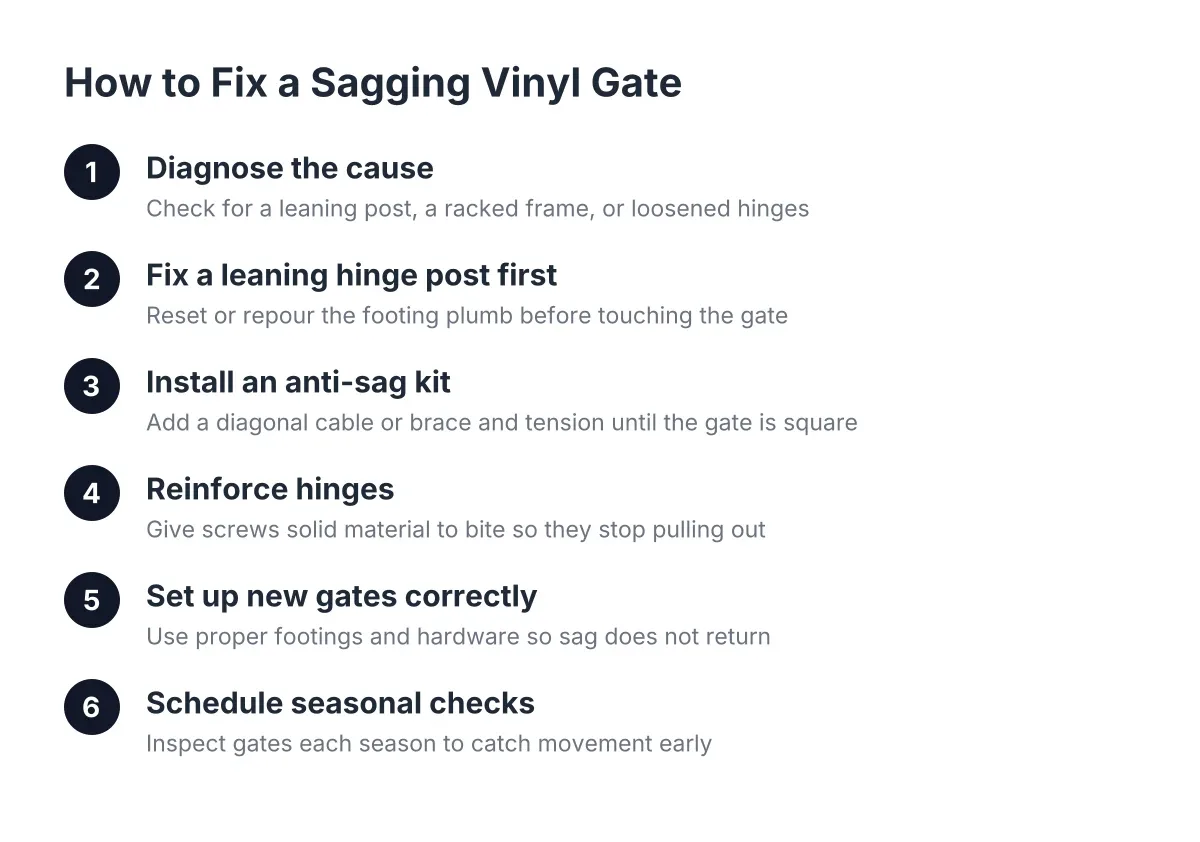
Step 1: Figure Out Why Your Vinyl Fence Gate Sags
Before you buy an anti-sag kit, diagnose the cause. A vinyl fence gate sags for one of three reasons, and each has a different fix:
- The hinge post is leaning. Put a level on the post. If it tilts toward the gate opening, the soil or the footing has moved. No gate adjustment will fix a leaning post for long.
- The gate frame is racking. The post is plumb, but the gate has gone out of square. The latch-side corner drops and the gate drags or misses the latch. This is a hardware and frame problem.
- The hinges have loosened. Screws pull out of hollow vinyl uprights over time. The gate droops on its hinges even though the frame and post are fine.
Open the gate halfway and let go. If it swings closed on its own, the hinge post leans into the opening. If the gate holds position but the latch corner sits lower than the hinge corner, the frame has racked. Check hinge screws last; wiggle the gate up and down at each hinge and watch for movement at the screw heads.
Ocala's conditions push on all three at once. Sandy soil lets posts tilt. Summer heat softens PVC and lets a heavy gate rack faster. Humidity and daily use work screws loose. Sort out which failure you have before moving on.
Why Sandy Soil Makes Vinyl Fence Gates Sag Faster Here
Vinyl fence gates sag faster in Ocala because sand does not grip a footing the way clay does. Loose, well-draining sand compacts unevenly, and heavy seasonal rain washes fine material away from the sides of a concrete footing. The post then rocks a little more each time the gate slams.
A gate post carries a cantilevered load that a line post never sees. Every swing levers against the footing. On a flat suburban lot that force is modest. On a rural property where the gate is wider, heavier, and opened by equipment traffic every day, the footing takes a beating. That is why gate posts need deeper, wider footings than the rest of the fence, and often internal reinforcement too.
Step 2: Fix a Leaning Hinge Post First
If the post leans, fix it before touching the gate. Dig out one side of the footing, push the post back to plumb with a helper holding a level, and pour new concrete around the exposed footing. Let it cure fully before re-hanging the gate.
However, if the original footing is shallow or the post was set in dry-packed sand with no concrete, patching will not hold. The better fix is to reset the post: pull it, dig a deeper and wider hole, and pour a proper concrete footing with the post braced plumb while it cures. In sandy ground, bell the bottom of the hole wider than the top so the footing resists tilting instead of pivoting.
For gate posts specifically, a reinforced post is worth the extra work. Installers often set a steel pipe in the concrete and sleeve the vinyl post over it. The vinyl stays as the clean white finish you wanted; the steel carries the gate load. On acreage perimeters with wide drive gates, this is the difference between a gate that works for years and one that sags every season.
This is also the step where it pays to be honest about scope. Resetting a gate post means demolition, digging, concrete work, and re-hanging, all in the right order. If the post moves again after one reset, or the fence line around it is also shifting, bring in a fence company to look at the footings rather than pouring concrete a third time.
Step 3: How to Fix Sagging Vinyl Gates With an Anti-Sag Kit
Once the post is plumb, square the gate. An anti-sag kit is a diagonal cable or rigid brace that pulls the low latch corner back up. Kits come in white or black to match the gate, and double gates need one kit per leaf.
Install the cable from the top hinge corner down to the bottom latch corner. That diagonal is the one that stretches when a gate racks, so that is the one you tension. Here is the sequence:
- Take the gate off its hinges and lay it on a flat surface, or work in place if the gate is too heavy to lift.
- Mount the upper bracket at the top hinge-side corner and the lower bracket at the bottom latch-side corner.
- Run the cable between them and thread on the turnbuckle, leaving it loose.
- Tighten the turnbuckle gradually while checking the diagonal measurements. The gate is square when both corner-to-corner diagonals match.
- Re-hang the gate and test the swing and latch. Fine-tune the turnbuckle until the latch catches cleanly.
Do not crank the turnbuckle past square. Over-tensioning bows a vinyl frame the other way and stresses the corner joints. Snug, square, and latching is the goal.
If the gate frame itself feels flimsy, the brace is treating a symptom. Larger or older gates may need vinyl gate framing that adds internal structure to the uprights and rails, and this is one way to fix a sagging vinyl gate that bends under load. A gate rebuilt around a proper frame plus a diagonal brace will outlast a hollow gate with a cable stretched across it.
Step 4: Reinforce Hinges So Screws Stop Pulling Out
Hollow vinyl uprights give screws little to bite. Over time the holes wallow out and the gate droops on its hardware even though the frame is square. The fix is to give the screws something solid.
Adding a P-channel insert inside the gate uprights strengthens the frame where the hinges mount, so screws hold instead of stripping. If your gate was assembled without inserts, a hardware kit with longer through-bolts and backing plates does a similar job from the outside. Replace any screw that spins freely; a hinge is only as strong as its worst fastener.
While you have the hardware apart, check the latch. For a pool fence gate this is not optional. Florida pool barrier rules require gates to be self-closing and self-latching and to swing outward, away from the pool. A sagging gate defeats the self-latch even when the hinges spring correctly, which is exactly what an inspector will flag. The stakes are real: according to the Centers for Disease Control and Prevention, a four-sided isolation fence around the pool cuts a child's drowning risk by 83% compared to property-line fencing alone. That protection only works when the gate closes and latches by itself, every time.
Step 5: Set Up New Gates So They Never Sag
Prevention is cheaper than repair, especially on a long run. If you are planning vinyl fencing for a perimeter or adding a gate to an existing line, build the gate opening differently from the rest of the fence:
- Oversize the gate post footings. Deeper and wider than line posts, with concrete, and belled at the bottom in sandy ground.
- Reinforce both gate posts. Steel pipe inside the vinyl sleeve on the hinge side at minimum; both sides for drive gates.
- Keep gate leaves narrow. Two 5-foot leaves sag less than one 10-foot gate. Wide openings on acreage do better as double gates with a drop rod.
- Spec the frame, not just the look. Internal reinforcement in the uprights and rails, plus a diagonal brace, from day one.
- Mind the slope. On grade changes, set the gate at the most level point in the run; a gate across a slope fights gravity from its first day.
For example, suppose a homeowner on five acres near Silver Springs Shores hangs a wide single vinyl gate on standard posts set in dry sand. By the second rainy season the hinge post tilts, the latch corner drags, and the gate gets propped open with a block, which defeats the point of the fence. The same opening built as a double gate on steel-reinforced posts in belled concrete footings would still swing true. The gate hardware costs more up front; the second installation does not happen.
One trade-off to know: steel-reinforced posts and framed gates add material and labor cost to those two posts and the gate itself. On a long perimeter that is a small share of the total job, and it is concentrated exactly where failures happen.
Step 6: Put Gate Checks on a Seasonal Schedule
Even a well-built gate needs a look twice a year in Ocala. The rainy season moves soil, and heat cycles work fasteners loose. Each check takes five minutes:
- Put a level on both gate posts and note any new lean.
- Swing the gate and listen for dragging; measure the gap at the latch corner against your last check.
- Snug the turnbuckle on the anti-sag brace if the diagonals have drifted.
- Test every hinge screw and latch fastener.
- For pool gates, release the gate from fully open and confirm it closes and latches on its own.
As a result, you catch a quarter-inch of settling before it becomes a dragging gate and a stripped hinge. On acreage, walk the gate openings whenever you walk the fence line for livestock. For pool gates, test the self-latch monthly during swim season; a latch that needs a push to catch is already out of compliance.
A sagging vinyl gate that sags is almost never a mystery in Ocala. It is sand moving under a footing, a hollow frame racking under its own weight, or screws losing their grip in PVC. Work through those three in order, reinforce the gate posts for the soil you actually have, and the gate will swing and latch the way it did on day one.
If you need vinyl fencing, Ocala Fence Builders can help.
Prefer to talk it through? Call (352) 670-3374 — a quick call is usually the fastest way to get a straight answer for your situation.