Vinyl Fence Gate Kit Installation in Ocala: 8 Ways to Stop Gate Sag
A vinyl fence gate kit looks simple in the box: two uprights, rails, pickets, hinges, and a latch. On an Ocala property, the gate is also the part of your fence most likely to fail first. Gates swing, slam, and carry weight on one post, and in sandy soil that post moves if it was not set right. This article walks through eight things that separate a vinyl fence gate that swings straight for years from one that drags the ground by next summer, whether you are fencing a new-build lot or a long perimeter run outside town.
If you are comparing vinyl fencing styles, parts, and gate options before you buy, these eight points will also help you judge an installer's work and ask the right questions before you sign an estimate.
1. Know What a Vinyl Fence Gate Kit Actually Includes
A standard vinyl fence gate kit includes the gate frame pieces, pickets or panel sections, hinges, and a latch. What it usually does not include matters more: the gate posts, the concrete, and any internal reinforcement. Big-box kits from Home Depot, Lowe's, or Menards are built to a price point, and the hardware that comes in the box is often the lightest hardware the gate can tolerate on day one.
For a gate that gets daily use, plan on upgrading at least the hinge hardware and reinforcing the hinge-side post. A fence company quoting your project should spell out whether reinforcement, posts, and concrete are in the estimate or billed as extras. If the quote does not mention gate post reinforcement at all, ask why.
2. Reinforce the Hinge Side, Not Necessarily the Latch Side
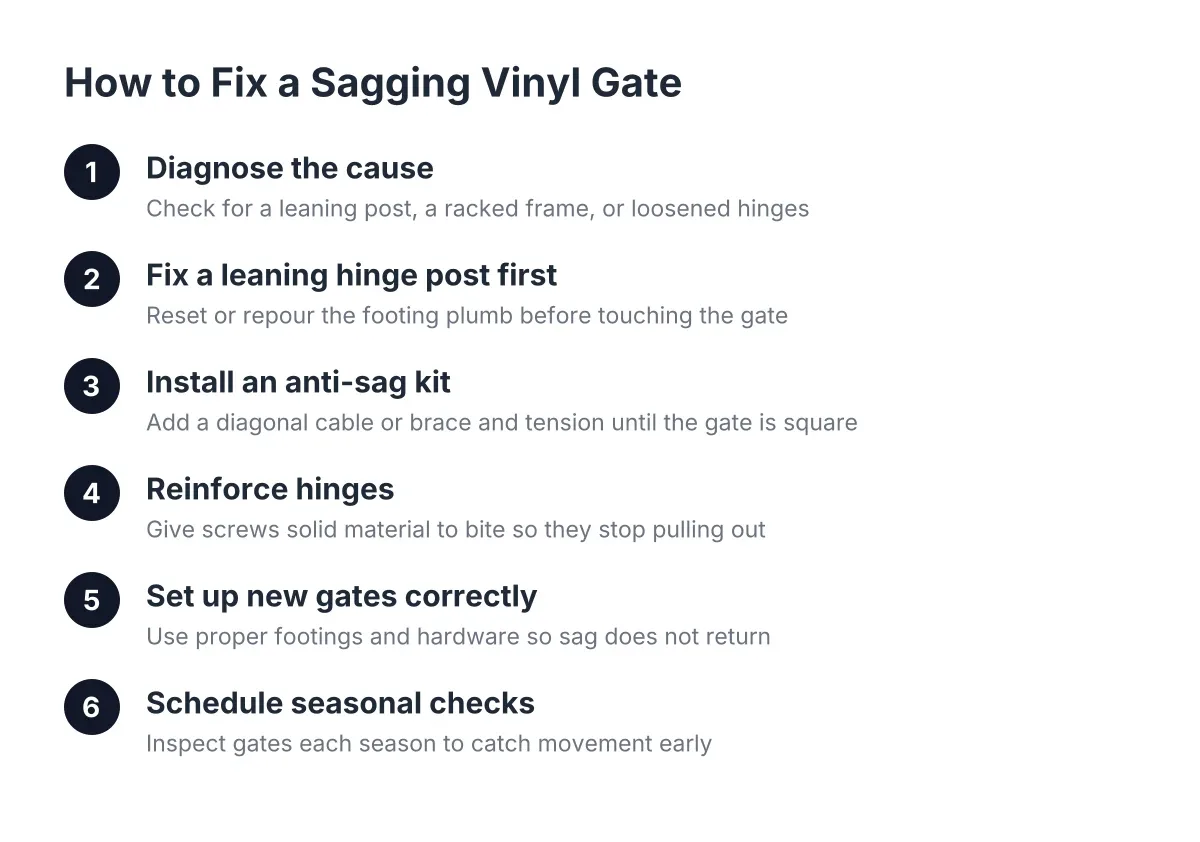
Gate sag almost always starts on the hinge side. That post carries the full weight of the gate every time it swings, so it needs either a steel or aluminum insert inside the vinyl post or a metal pipe the vinyl post sleeves over. The latch side is a different story. Latch hardware rarely rips out of a post, so the latch post usually does fine without an insert.
This is where homeowners waste money or cut the wrong corner. Reinforcing both posts adds cost you may not need; reinforcing neither guarantees sag. Put the reinforcement where the load is. On a wide gate or a double drive gate for equipment access, reinforce both hinge posts and treat the latch posts as standard.
3. Ocala's Sandy Soil Changes How Gate Posts Get Set
Sandy and shifting soil is the main reason gates sag in Ocala and the surrounding areas. A post hole in sand does not grip concrete the way clay does, so a footing sized for a standard fence post is often too small for a gate post. Deeper holes, wider footings, and properly cured concrete matter more here than in most of the country.
Heavy seasonal rain makes it worse. Water moving through sandy soil can shift a shallow footing over a few wet seasons, and the gate is the first place you notice it because the latch stops lining up. If you own acreage in Citra, Silver Springs Shores, or out toward Hernando, this applies to every gate on the run, from the walk gate by the house to the drive gate at the road.
4. Strengthen the Gate Frame Itself Before It Leaves the Ground
The posts are only half the sag problem. The gate frame can rack, meaning the rectangle slowly pulls into a parallelogram. Adding a P-channel insert inside the gate uprights gives the screws something solid to bite into, which makes the frame far more resistant to pulling apart at the corners. Hollow vinyl alone does not hold screws well under repeated swinging loads.
A few frame details worth checking on any vinyl fence gate, kit-built or custom:
- Internal stiffeners or P-channel in the uprights so hinge and latch screws hold long term
- Rails cut to fit snugly, not loose in their pockets, before they are secured with the proper screws
- Corner connections that are screwed into reinforced material, not just into hollow PVC
- A diagonal brace or truss rod on wider gates to fight racking
Each of these costs little during assembly and a lot to retrofit after the gate starts dragging.
5. Match the Gate Width to the Job, Especially on Acreage
A new-build lot in a planned community usually needs one walk gate and maybe a double gate for the mower. A rural perimeter is different. If you run horses, haul trailers, or need tractor access, a standard walk-gate width will frustrate you within a month. Wider gates weigh more, which loops back to points two and four: wider means more reinforcement, bigger footings, and heavier hinges.
Suppose a buyer closes on two acres outside Ocala and wants vinyl across the road frontage with a drive gate for a horse trailer. In that scenario, the gate posts might be the most engineered part of the whole fence, with steel-reinforced posts in oversized footings, while the rest of the run uses standard vinyl fence parts. That is normal, and it is why the gate section of an estimate costs more per foot than the panel runs.
6. Check HOA and Permit Rules Before the Vinyl Fence Gate Kit Arrives
Vinyl fence gate kits come in specific heights, widths, colors, and picket styles, and your HOA may only approve some of them. Fencing is a factor in 23% of HOA violation notices according to Forbes, tied for the second most common issue behind landscaping. For a new-build buyer in a planned community, that means confirming gate height, color such as white or tan, and style in writing before ordering anything.
Permits matter too. Fence installation in and around Ocala can require a permit depending on location and fence type, and the gate is part of the permitted structure. A local fence company handles this as part of the job; a DIY kit buyer has to check it themselves. Also confirm the property line before setting gate posts, since a gate set on a neighbor's side of the line is an expensive thing to move.
7. Decide Honestly Between DIY and a Pro Install
A handy homeowner can assemble a vinyl fence gate kit. The instructions are manageable, and panels can be built pickets-first or rail-first; both methods work. The hard part is not assembly. It is setting two gate posts plumb, at the exact opening width, in sandy soil, with the right reinforcement and enough concrete, then hanging the gate so it swings true.
Here is a reasonable dividing line:
- DIY-friendly: assembling the gate frame, installing the latch, adjusting hinges, replacing a cracked picket or slat
- Call a pro: setting or resetting gate posts, adding steel reinforcement, correcting a sagging gate that has pulled its screws, any gate in a pool fence
Pool gates deserve their own caution. A four-sided pool fence that separates the pool from the house and yard cuts a child's drowning risk by 83% according to the Centers for Disease Control and Prevention, and the gate is the weak point of that barrier. Self-closing, self-latching hardware on a pool gate is a safety requirement, not an upgrade, and it is worth having a professional verify it works every time.
8. Repairing a Sagging Vinyl Gate Is Often Cheaper Than Replacing It
A sagging gate does not always mean a failed gate. If the posts are still solid, a repair might be as simple as new hinges, a truss rod, or adding internal reinforcement the original install skipped. If a post has shifted in the sand, the fix is resetting or sleeving that post over a steel pipe while keeping the rest of the fence intact. Smart interim repairs that preserve good footings keep the fence standing and let that money count toward an eventual upgrade instead of being wasted.
However, there are limits. If the gate frame has cracked at the corners, if UV exposure has made the vinyl brittle, or if both posts have moved, replacement with proper reinforcement usually beats repeated repairs. A fence repair visit can tell you which situation you have. Cost drivers for gate repair include post condition, gate width and weight, reinforcement needed, and access to the site; no honest company can price it without seeing how the posts sit in the ground.
What Drives the Cost and Timeline of a Vinyl Gate Install in Ocala
No two gate installs price the same, but the cost factors are consistent in 2026. Gate width and height, hinge-side reinforcement, footing size for sandy soil, hardware quality, and whether the gate ties into new vinyl fencing or an existing run all move the number. Searching for vinyl fence parts near me or ordering a kit online gets you materials pricing only; the labor and the post work are where gate budgets actually live.
Timeline-wise, the concrete is the constraint. Gate posts need to cure before the gate hangs on them, so even a small gate job is rarely a same-day swing-and-latch affair. For a full perimeter with multiple gates on acreage, expect the gates to be set early and hung near the end of the job.
Questions to Ask Before You Hire a Fence Company for Gate Work
Three questions separate a thorough quote from a thin one. First, how will you reinforce the hinge-side post, and is that included in the estimate? Second, how deep and wide are your gate post footings in sandy soil? Third, what hardware are you installing, and what happens if the gate sags later?
A fair estimate names the gate size, the reinforcement method, the hardware, and whether permits and property line verification are handled. If a quote reads like it was priced for a small suburban yard and you own acres of frontage, say so up front; a company used to long perimeter runs will measure the property and price per foot with the gates itemized separately.
If you are in Ocala or the immediately surrounding areas and your vinyl gate is sagging, dragging, or not latching, or you are planning new fence installation with gates that need to hold up in sandy soil, reach out to Ocala Fence Builders for an estimate. We will look at the posts, the soil, and the gate itself, and tell you plainly whether repair or replacement makes sense.
If you need fence installation in Ocala, FL, Ocala Fence Builders can help.
Prefer to talk it through? Call (352) 670-3374 — a quick call is usually the fastest way to get a straight answer for your situation.