Why Pool Gates Fail in Sandy Ocala Soil: 8 Causes and How to Prevent Them
If you own acreage around Ocala, you already know what the ground does to posts. Pool gates fail in sandy soil for the same reasons pasture gates sag: the ground shifts, the posts lean, and the hardware stops lining up. Understanding the causes of pool gate failure in sandy conditions is essential for maintaining a safe barrier. The difference is that a sagging pasture gate is an annoyance, while a pool gate that will not self-close is a safety problem and a code problem. This article walks through the eight most common reasons pool gates fail in sandy Ocala conditions, and what to do about each one before an inspection or, worse, an accident forces the issue.
The stakes are higher than most fence work. According to the Florida Governor's Office, the majority of the state's child drowning deaths in the reported period happened in swimming pools, with 46 total deaths cited. The gate is the single moving part in the whole barrier. When it fails, the fence fails.
1. Gate Posts Set Too Shallow for Shifting Sand
The number one reason pool gates fail in sandy ground is a gate post that was set like a line post. A gate post carries constant lateral load every time the gate swings, and Ocala's loose, fast-draining sand gives that load nothing to push against. Over a year or two, the post rocks a hairline gap into the sand around its footing, leans toward the gate, and the latch stops catching.
Prevention is straightforward: gate posts need deeper footings and a larger concrete footprint than the rest of the run. A post with a generous concrete collar on all sides resists the rocking motion that sand allows. If your current gate post moves when you push on it by hand, no hinge adjustment will fix the gate for long.
2. Undersized Concrete Footings That Crack Under Load
A footing that is too narrow for the post does not just settle; it breaks. Concrete poured in a small-diameter hole can crack under repeated lateral force from the gate, and the break becomes a permanent wobble point below grade where you cannot see it. The gate then swings out of plumb no matter how many times you re-hang it.
Therefore, if a pool gate has been adjusted twice and still drifts out of alignment, suspect the footing rather than the hardware. The fix usually means pulling the post and re-setting it properly. One note for anyone planning a DIY repair: posts concreted within the past year are far harder to pull than older ones, which often pop out with little effort.
3. Latch Strikers Installed With No Room for Settling
Sandy soil settles, and a good installer plans for it. The latch striker should sit near the top of the latch's catch range on day one, so the gate still latches as the ground drops the gate slightly over the following seasons. A striker installed dead center or near the bottom of its range leaves no travel, and the first half inch of settling puts the latch out of reach.
For example, this is the detail that separates a pool fence crew that works in Ocala sand from one that works on compacted clay. On clay, center-set strikers last for years. On sand, they fail the first wet season. If your self-latching gate catches only when you lift it, the striker has run out of settling room and needs repositioning.
4. Self-Closing Hinges That Lose Tension in Humidity and Grit
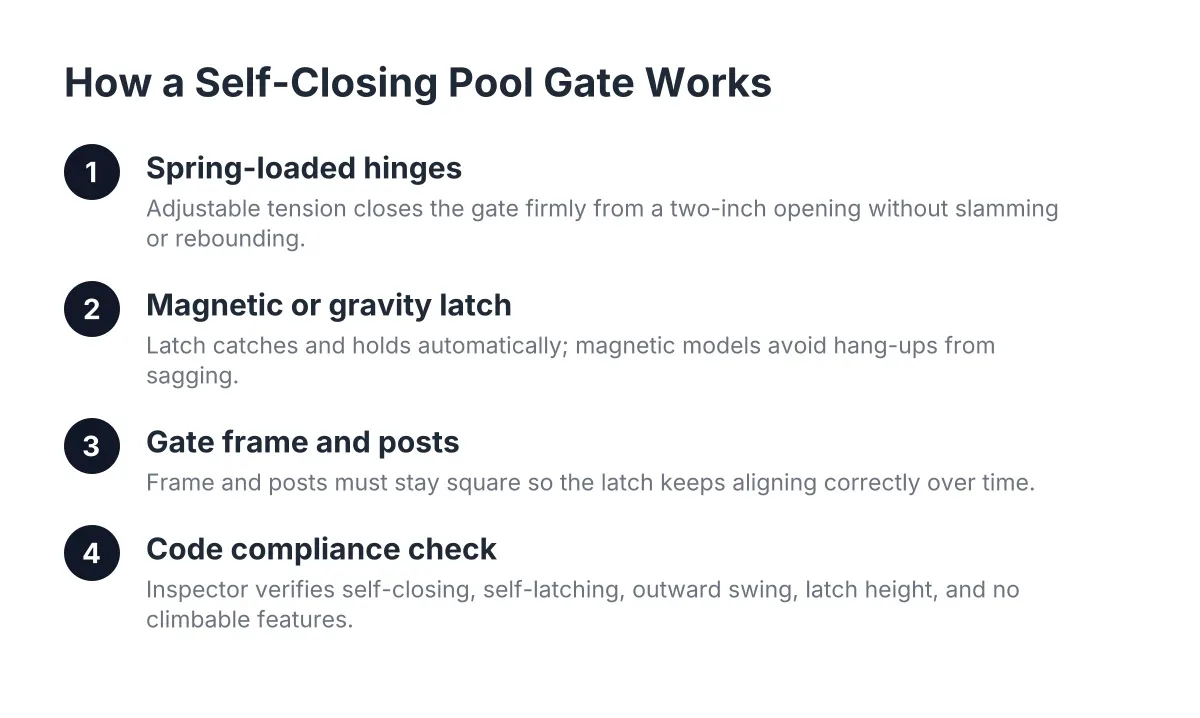
Spring-loaded hinges are the heart of a code-compliant pool gate, and they take a beating here. Ocala's humidity corrodes cheap spring mechanisms, and wind-blown sand works into the hinge barrel and grinds the action until the gate drifts shut instead of closing firmly. A gate that closes but does not latch counts as a failed gate at inspection and in real life. Hinge problems represent a primary cause of pool gate failure in sandy environments where moisture and abrasive particles degrade mechanical components.
As a result, hinge checks should be part of your routine, the same way you walk your pasture lines after a storm:
- Open the gate to 90 degrees and release it; it must swing closed and latch on its own, every time.
- Open it six inches and release it; a compliant gate latches even from a near-closed position.
- Listen for grinding in the hinges; grit inside the barrel means cleaning or replacement.
- Check tension adjustment screws seasonally; humidity swings change how much force the spring needs.
5. Gates That Swing the Wrong Direction
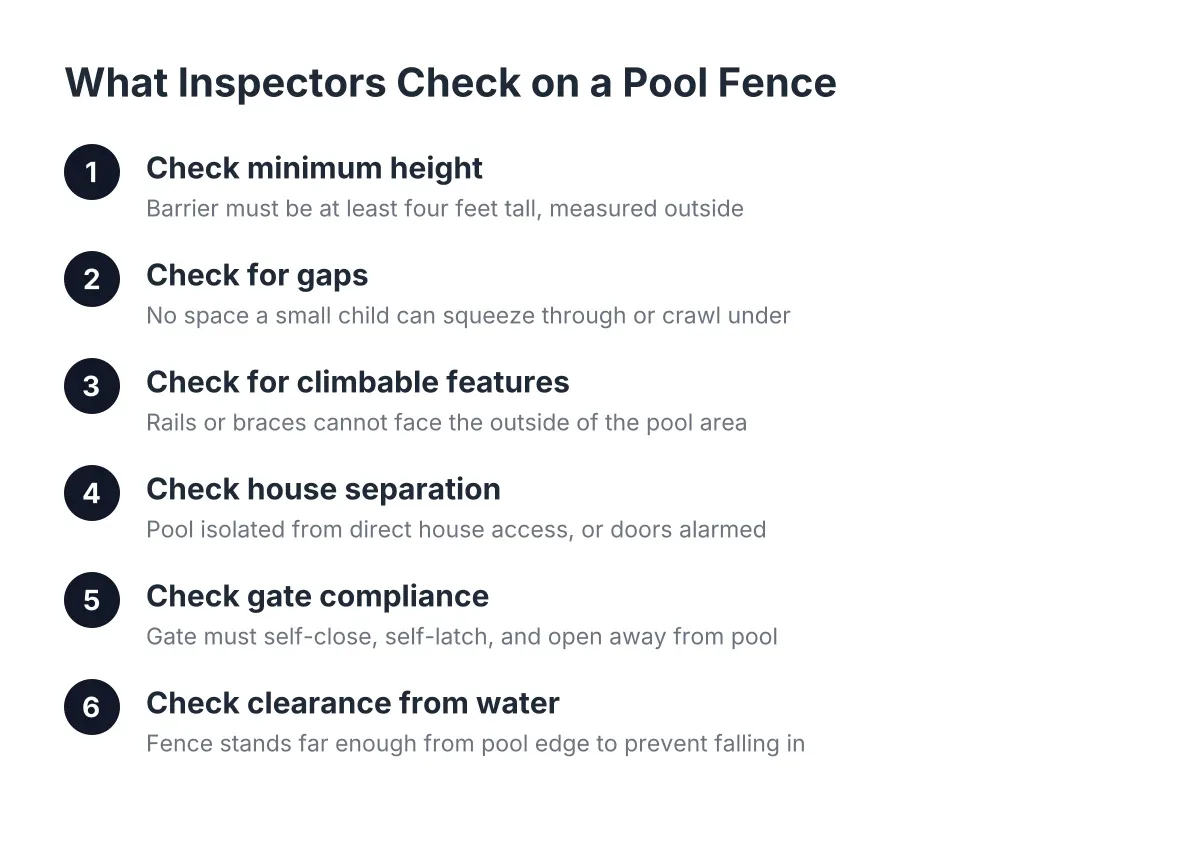
Pool code requires the gate to swing outward, away from the pool. A gate that opens toward the water can be pushed open by a child leaning on it, while an outward-swinging gate forces them to pull against the latch. On rural properties where the pool fence meets a longer perimeter run, installers sometimes hang the gate to match the perimeter gates, which often swing inward for livestock handling.
In addition, swing direction interacts with settling. An outward-swinging gate on a leaning post tends to fall open; an inward one tends to jam. Neither is acceptable, but the open-falling failure is the dangerous one, because the barrier is simply standing open. Confirm swing direction before you sign off on any pool fence installation or fence repair.
6. Rails and Pickets Facing the Climbable Side Out
Code requires horizontal rails to face the pool side, not the approach side. Exposed rails on the outside are a ladder, and a determined child does not need long to use one. A study cited by the National Institutes of Health found four-year-olds climbed a five-foot fence in a median of 17 seconds, which shows height alone does not stop climbing.
Many acreage owners prefer the finished picket side of a wood fence facing their own yard, which is the standard choice everywhere except around a pool. With a pool inside the fence, that preference flips the climbable rails toward the outside and fails code. This is one of the most common corrections on older ranch properties where a pool was added inside an existing wood fence.
7. Wood Gate Posts Rotting at the Ground Line
Wood posts in Florida fail at grade, where moisture concentrates, even when the panels above look fine after years of repainting. A common install shortcut makes it worse: filling concrete to a couple inches below grade and topping with dirt or sod. That dirt cap holds water against the post at exactly the point of highest stress, and the post rots through at ground level while looking solid above.
However, there is a trade-off worth knowing before you spec replacements. Concrete poured tight against wood can trap moisture and speed rot compared to a well-draining backfill, so post material and footing detail should be decided together. For a pool gate specifically, many owners switch to an aluminum fence gate post even when the surrounding run is wood, because the gate post does the most work and fails first.
8. Causes of Custom Pool Gate Failure in Sandy Conditions
Wide custom pool gates, the kind acreage owners want for mower or utility-vehicle access into the pool yard, multiply every problem above. A wider, heavier gate leaf puts more leverage on the hinge post, and in sand that leverage shows up as sag within the first year unless the post and footing are sized for it. Custom pool gates can absolutely meet code, but they need engineering for the load, not just a wider frame.
Suppose a homeowner on ten acres outside Citra wants a five-foot walk gate plus a wide drive gate into the pool enclosure for equipment access. In that scenario, the right approach is a heavier hinge post with an oversized footing on the drive gate, a self-closing and self-latching walk gate for daily use, and the drive gate kept padlocked except when equipment moves through. The daily-use gate carries the safety function; the utility gate stays locked.
How to Check Whether Your Pool Gate Is Failing in Sandy Ground
A pool gate failing in sandy soil shows three early signs: the post moves under hand pressure, the gate latches only when lifted, and the latch gap changes between dry and wet seasons. Any one of these means the ground is moving under the gate, and the problem will get worse, not better, on its own.
Run this quick check twice a year, ideally before summer swim season and after the heavy rains:
- Push the gate post firmly at shoulder height; any visible movement at grade means the footing is compromised.
- Release the gate from fully open and from six inches open; it must self-close and self-latch both times.
- Measure the gap under the gate; a growing gap on the latch side means the hinge post is leaning.
- Check that the latch release sits out of a small child's reach and that no rails face outward as footholds.
- Look at the base of wood posts for soft spots at the ground line, the usual failure point.
Keep in mind what the barrier is for. According to the Centers for Disease Control and Prevention, a four-sided isolation fence separating the pool from the house and yard cuts a child's drowning risk by 83 percent compared to three-sided property-line fencing. A pool safety fence only delivers that protection when the gate closes and latches every single time, which is why gate function deserves more attention than any other part of the fence. A 2025 study indexed on PubMed estimates proper pool isolation fencing, combined with consistent life jacket use, could prevent 348 U.S. drowning deaths and $4.5 billion in costs each year. The gate is where that protection holds or breaks.
One honest limitation: a visual check tells you the gate works today, but it cannot tell you what the footing looks like below grade or whether the install meets current code. If your gate has failed more than once, or you are prepping for a 2026 inspection, have a fence company that works in Ocala's soil evaluate the posts and footings directly. Cost factors for a gate rebuild come down to post material, footing size, gate width, and whether the surrounding pool fence needs correction too; an on-site estimate is the only way to pin that down for a specific property.
If you need pool safety fence installation, Ocala Fence Builders can help.
Prefer to talk it through? Call (352) 670-3374 — a quick call is usually the fastest way to get a straight answer for your situation.