Pool Safety Fence Code in Ocala, FL: What Inspectors Check Before They Pass You
Your pool is finished, the water is in, and the kids are asking when they can swim. Then the inspector walks the yard and tells you the fence will not pass. For a lot of Ocala homeowners, that is the first time they hear the words pool safety fence code. It is a frustrating way to learn that a pool barrier is not just any fence, and that Florida has specific pool fence inspection requirements about height, gaps, gates, and even which side of the fence the rails face.
This guide walks through what the pool safety fence code actually requires in Florida, how inspections play out in Marion County, and the small details that cause most failures. The goal is simple: pass the inspection the first time, and never pay for the same fence twice.
Why Florida Treats Pool Fencing Differently Than Other Fencing
A privacy fence keeps the neighbor's dog out. A pool fence keeps a toddler alive. That is the blunt reason Florida writes its pool barrier rules into state law instead of leaving them up to each city.
The numbers behind the law are hard to argue with. From 2018 to 2020, Florida pool drownings made up 18.7% of all U.S. pool drowning fatalities, the highest share of any state, according to WFLA. Florida's overall drowning rate is 54% higher than the national average, according to a study reported by NBC Miami. Backyard pools are everywhere here, and small children can reach them in seconds.
Fencing works when it is built right. A four-sided isolation fence that separates the pool from both the house and the yard reduces a child's risk of drowning by 83% compared to three-sided property-line fencing, according to the Centers for Disease Control and Prevention. That one statistic explains most of what the code asks for. The barrier has to fully surround the pool, and it has to resist a determined four-year-old, not just mark a boundary.
In addition, a 2025 study reported through PubMed estimates that proper pool isolation fencing and consistent life jacket use together could prevent 348 U.S. drowning deaths and $4.5 billion in economic costs each year. The code is not bureaucratic box-checking. It reflects what actually keeps kids out of the water when no adult is watching.
What the Florida Pool Safety Fence Code Requires in 2026
Florida's Residential Swimming Pool Safety Act sets the baseline for every residential pool barrier in the state, and the Florida Building Code fills in the construction details. Marion County enforces these rules through its building department, so what the inspector checks in Ocala follows the state standard. As of 2026, the core requirements have stayed consistent, and they come down to a handful of measurable rules.
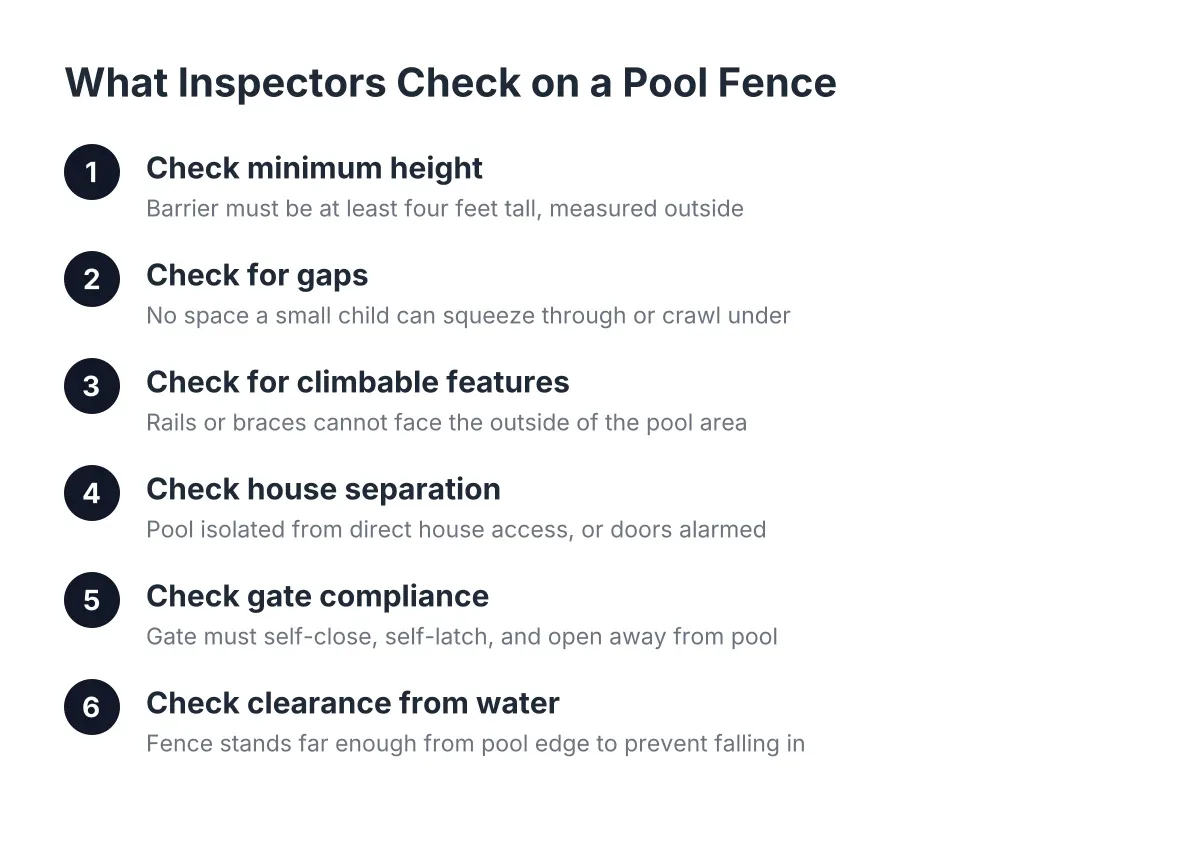
Here is what the inspector is looking for:
- Minimum height. The barrier must be at least four feet tall, measured on the outside of the fence. Pool fence inspection requirements start with height, which is checked from the ground, so dips in sandy Ocala soil along the fence line matter.
- No gaps a child can pass through. The space under the fence and the gaps between pickets or mesh must be small enough that a small child cannot squeeze through or crawl under.
- No climbable features. Horizontal rails, cross braces, or decorative features that work like a ladder cannot face the outside of the pool area.
- Separation from the house. The barrier must isolate the pool from direct access, or doors leading to the pool must have approved alarms or other protections.
- Self-closing, self-latching gates. Every gate in the barrier must close and latch on its own, open away from the pool, and have the latch mounted high enough that a toddler cannot reach it.
- Clearance from the water. The fence has to stand far enough from the pool edge that a child who gets over it does not fall straight into the water.
None of these rules are optional, and none are negotiable with the inspector. However, there is flexibility in how you meet them. Aluminum, vinyl, wood, chain link, and removable mesh can all satisfy the pool safety fence code when they are built to these specs. Mesh is not required, and neither is aluminum; they are simply common choices because they meet the height and gap rules easily and do not block your view of the pool.
One honest caveat: this article is general guidance, not a permit document. Code language gets amended, and Marion County can interpret details differently than a neighboring county. Before you build, confirm current requirements with the Marion County building department or a fence company that works under these inspections regularly.
Gate Compliance: Where Most Pool Fence Inspections Fail
Ask anyone who deals with pool inspections and they will tell you the same thing. The fence usually passes. The gate fails.
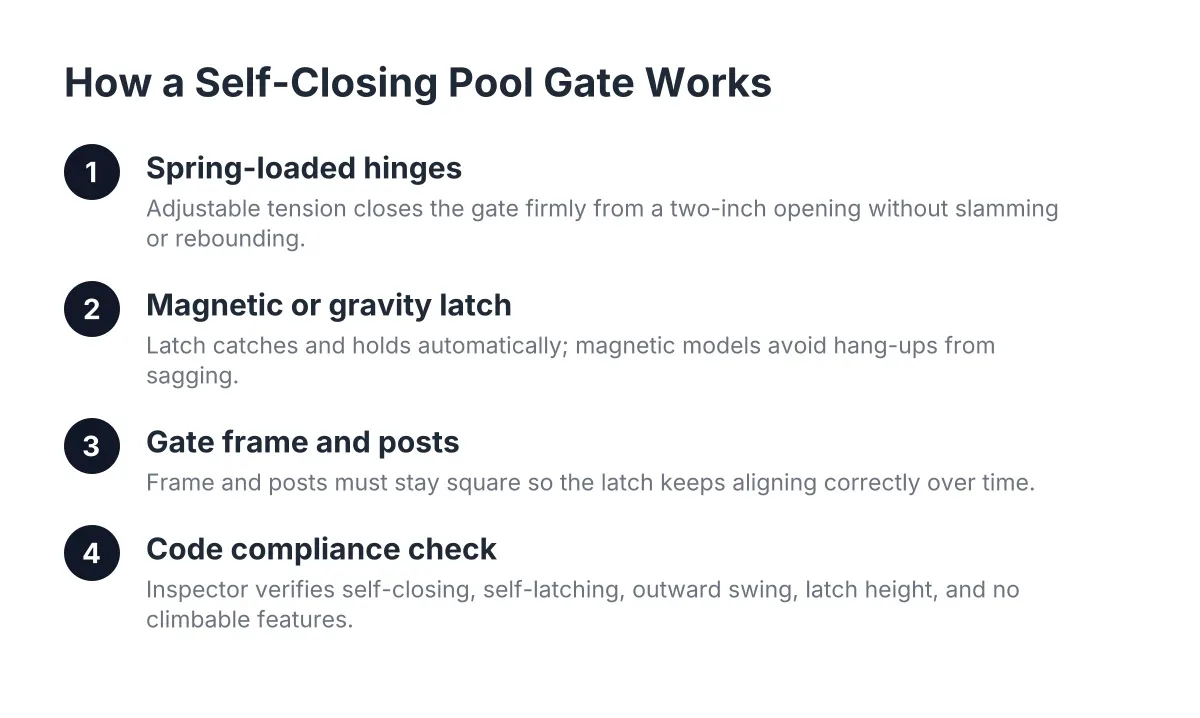
The code asks a lot of a pool gate. It must swing outward, away from the pool. It must close itself from any open position. Additionally, it must latch itself without a human hand. The latch must sit high enough, or be shielded well enough, that a young child cannot work it. Miss any one of those and the inspection fails, even if the other two hundred feet of fence are perfect.
Ocala adds its own complication: sandy, shifting soil. A fence gate that self-latched in March can sag out of alignment by August after a wet season softens the ground around the posts. When the gate sags, the latch misses its catch, and the gate drifts open behind you. That is both an inspection failure and a genuine hazard, because a gate that almost latches gives you false confidence.
For example, suppose a family in a newer Ocala development finishes a pool in spring. The pool contractor's work passes, but the inspector flags the gate because it swings toward the pool and the latch sits at waist height. In that scenario, the fix is not a new fence. It is rehanging the gate to swing outward, adding a spring-loaded self-closing hinge, and moving the latch to the required height. That is a day of work, not a second fence. Knowing that ahead of time is the difference between a scramble and a scheduled repair.
Gate hardware is also where cost worries tend to shrink. Self-latching hardware and self-closing hinges add to the price of a standard gate, but they are a small fraction of the total fence cost. The expensive mistake is building a full fence with non-compliant gates and paying a crew to come back.
The Rail Direction Mistake That Fails Wood Fences
This one surprises more homeowners than any other rule. If you install a wood fence around a pool, the smooth picket side must face outward, and the horizontal rails must face in toward the pool.
Most homeowners want the opposite. The picket side looks better, so people naturally want it facing their own yard. With a pool, that preference fails inspection. Exposed rails on the outside of the fence work like ladder rungs. A child in the neighbor's yard, or on the street side of the fence, can step on the bottom rail, grab the top, and climb over. The pool safety fence code closes that gap by requiring the climbable side to face the protected area.
Therefore, if you are re-fencing a yard that already has a pool, check your existing wood fence before the inspector does. Walk the outside of the fence line. If you can see horizontal rails from outside the pool area, that section will likely get flagged. Sometimes the fix is adding pickets to the rail side so both faces are smooth. Sometimes it means rebuilding sections. Either way, it is cheaper to catch it yourself.
The same logic applies to chain link. Standard residential chain link with small mesh openings can pass, but older fences with large diamond openings give a child toe holds. An inspector will treat a climbable chain link fence the same way they treat exposed rails.
How Pool Fence Inspection Requirements Play Out at a Marion County Inspection
A Marion County pool barrier inspection is a walk-through with a checklist, and knowing the sequence takes the mystery out of it. The inspector measures fence height from outside the barrier, checks gaps at the ground and between pickets, tests every gate for self-closing and self-latching action, and looks for anything climbable near the fence.
That last point trips people up. The code cares about the barrier as it actually functions, not as it was drawn. A compliant four-foot fence with a patio chair, an AC unit, a planter, or a stacked firewood pile against the outside of it is no longer a four-foot barrier. Inspectors look for these launch points, and so should you before inspection day.
Ground conditions matter too. Ocala's flat lots and sandy soil mean fence lines can develop low spots where rain washes soil away from the bottom rail. A gap that was fine at install can grow past the allowed limit after a heavy summer. Check the bottom of the fence line after the rainy season, especially under gates, where foot traffic compacts and erodes soil fastest. Some homeowners add a continuous concrete curb along the fence base; it stops erosion gaps and keeps dogs from digging under at the same time.
Here is a pre-inspection walk you can do yourself in twenty minutes:
- Measure fence height at the lowest ground point along the outside, not the highest.
- Open every gate halfway and let go. It must close and latch on its own, every time.
- Push on the latched gate. If it pops open, the latch or alignment fails.
- Check which way gates swing. Away from the pool passes; toward it fails.
- Scan the outside face for rails, braces, or decorative cutouts a child could climb.
- Clear anything within a few feet of the outside of the fence that could be climbed.
- Look under the full fence line for erosion gaps, especially after rain.
If everything on that list checks out, you have covered the items that fail most residential inspections.
HOA Rules, Property Lines, and the Two-Fence Problem
Passing code is the floor, not the whole job. In many Ocala developments, the HOA has its own say about fence height, material, and color, and those rules can conflict with what you planned. Fencing disputes are common; a Forbes-reported survey found fencing is a factor in 23% of HOA violation notices, tied as the second most common issue behind landscaping.
Here is the tension. The code may accept a four-foot chain link fence around your pool, but your HOA may prohibit chain link entirely and require vinyl or aluminum in an approved color. Neither authority overrides the other. You have to satisfy both, which means getting HOA approval in writing before anyone sets a post.
Property lines create a second trap. A pool barrier does not have to sit on the property line; it has to surround the pool. Some homeowners solve HOA and code conflicts with a two-fence approach: a decorative wood or vinyl fence on the property line for privacy, and a shorter aluminum or mesh pool fence closer to the water as the code barrier. That inner fence is a true isolation barrier, the four-sided layout the CDC's 83% risk-reduction figure is based on, and it often looks better around the pool deck than a tall perimeter fence would.
Businesses face a version of this too. A hotel, apartment complex, or RV park pool in the Ocala area falls under commercial fencing rules that are stricter in some respects, and liability exposure raises the stakes. Commercial property managers should treat the pool barrier as part of the perimeter security plan, not an afterthought, and have it inspected on a schedule rather than waiting for a complaint.
What Compliance Actually Costs, and What Drives the Price
The fear behind most pool fence delays is cost. Homeowners assume a code-compliant fence is a different, more expensive product than a regular fence. Mostly, it is not. The code governs dimensions and hardware, not luxury.
Rather than quote figures that go stale, here are the cost factors that actually move an estimate for a pool safety fence in Ocala:
- Material choice. Removable mesh, chain link, aluminum, vinyl, and wood each sit at different price points and different maintenance expectations in Florida humidity.
- Linear footage and layout. An isolation fence close to the pool uses less material than fencing the whole backyard, which can make the safer layout the cheaper one.
- Gate count and hardware. Each gate needs self-closing hinges and a compliant latch, so more gates means more hardware cost.
- Soil and post setting. Sandy or soft ground may call for deeper posts or more concrete to keep gates aligned long term.
- Custom styles. Board-on-board, horizontal designs, and decorative tops use more material and labor than a standard flat-face fence, so they cost more for the same footage.
- Fixing versus replacing. Bringing an existing fence up to code, by moving latches, adding pickets over exposed rails, or rehanging gates, often costs far less than a new fence.
Get an itemized estimate that separates the fence from the gates and hardware. That makes it easy to see where compliance costs sit, and it is usually less than people fear.
Pass Once, Then Keep Passing
The inspection is a snapshot. The fence has to keep doing its job every day after, through Ocala's rain, humidity, and shifting soil. A barrier that passed in 2026 can drift out of compliance by next summer if the gate sags or the ground erodes.
Build two habits. First, test every pool gate monthly: open it halfway, release it, and confirm it latches without help. Second, walk the fence line after the rainy season and look for new gaps at the ground, leaning posts, or anything stacked against the outside of the fence.
The pool safety fence code exists because unsupervised seconds around water are the ones that matter. Meet the height, close the gaps, get the gates right, and face the rails inward. Do that, and the inspection takes care of itself. More to the point, so does the thing the inspection stands in for: a child reaching the fence and getting no further.
If you need fence installation in Ocala, FL, Ocala Fence Builders can help.
Prefer to talk it through? Call (352) 670-3374 — a quick call is usually the fastest way to get a straight answer for your situation.