Self-Closing Pool Safety Gates in Ocala: Installation and Upkeep Guide
If you just put in a pool, or an inspector flagged your gate, the gate is almost always where a pool fence passes or fails. Florida code requires a self-closing pool gate on every pedestrian opening in a pool barrier, and it has to latch on its own, every time, without help from an adult. This guide walks through how self-closing gates work, how Ocala's sandy soil and humid summers affect them, what to look for in hinges and latches, and how to keep the gate working after it passes inspection.
The fence around the pool matters too, and we cover how the gate ties into the rest of the barrier. But if you only have time to get one thing right before your inspection, make it the gate.
Why the Gate Is the Weak Point of Any Pool Barrier
A fence is a fixed object. A gate is a moving part that gets opened dozens of times a day during swim season. Kids push through it with towels and floats. Adults prop it open while carrying coolers. Pool techs leave it swinging behind them.
That constant use is exactly why Florida's barrier rules treat the gate differently from the rest of the fence. A fence panel can't forget to close. A gate can, unless the hardware closes it automatically.
The stakes are real. According to WFLA, Florida pool drownings made up 18.7% of all U.S. pool drowning fatalities from 2018 to 2020, the highest share of any state. And the Florida Governor's Office reported 46 child drowning deaths in the reported period, with most occurring in swimming pools. A gate left ajar for even a few minutes is the most common way a young child reaches the water unsupervised.
There is one more number worth knowing. According to the Centers for Disease Control and Prevention, a four-sided isolation fence that separates the pool from the house and yard reduces a child's drowning risk by 83% compared to three-sided fencing that uses the house as one side. The self-closing pool gate is what makes that four-sided barrier actually work. Without it, the fence is only as good as the last person who walked through.
What Self-Closing Pool Gate Safety Hardware Must Do Under Florida Code
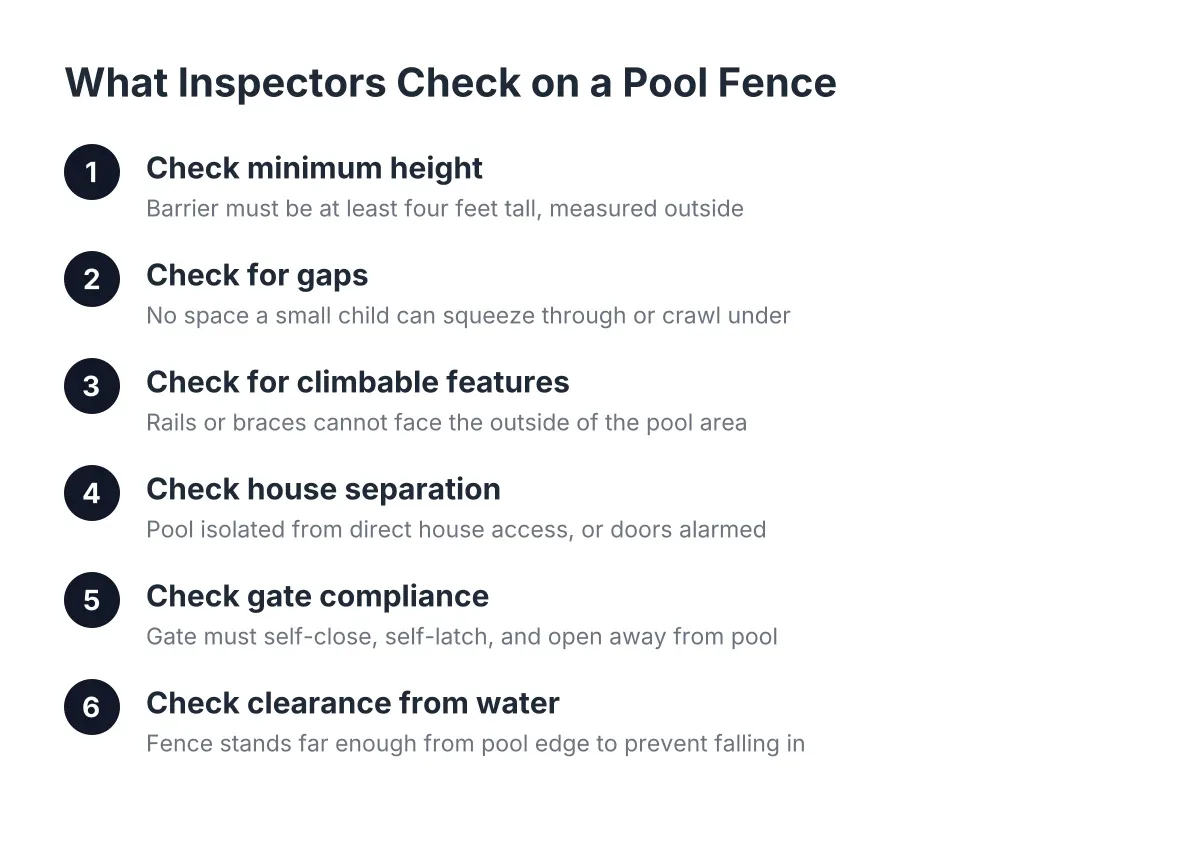
Florida's residential pool barrier rules set specific requirements for every pedestrian gate in a pool fence. As of 2026, the inspector in Marion County will check all of these before passing a new pool:
- Self-closing. The gate must swing shut on its own from any open position, including when it is barely cracked open. Spring-loaded hinges handle this.
- Self-latching. The latch must catch and hold without anyone touching it. A gate that closes but bounces off the latch fails.
- Opens outward, away from the pool. If a child leans or pushes on the gate, it should press into the latch, not swing open toward the water.
- Latch height or shielding. The release mechanism has to sit high enough that a toddler cannot reach it, or it must be shielded so small hands cannot work it from the outside.
- No climbable features near the latch. A cross brace, a planter, or a stack of pool toys next to the gate can turn into a step stool.
These requirements apply whether your pool fence is aluminum, vinyl, chain link, or mesh. The material changes the look and the cost factors; it does not change what the gate has to do.
One misconception trips up a lot of Ocala homeowners re-fencing around a pool. On a wood privacy fence, people like the finished picket side facing their own yard. With a pool inside that fence, code requires the rails to face the pool side. Exposed horizontal rails on the outside are a ladder for a child. If an inspector sees climbable rails facing the neighbor's side or the street side of a pool barrier, that fence gets flagged, and flipping panels after the fact is expensive. Getting this right during fence installation is far cheaper than fixing it during inspection week.
Height alone will not save you either. A National Institutes of Health study found children four years old took a median of just 17 seconds to climb a five-foot fence. That is why inspectors look at climbability and latch function, not just a tape measure.
How a Self-Closing Pool Gate Actually Works
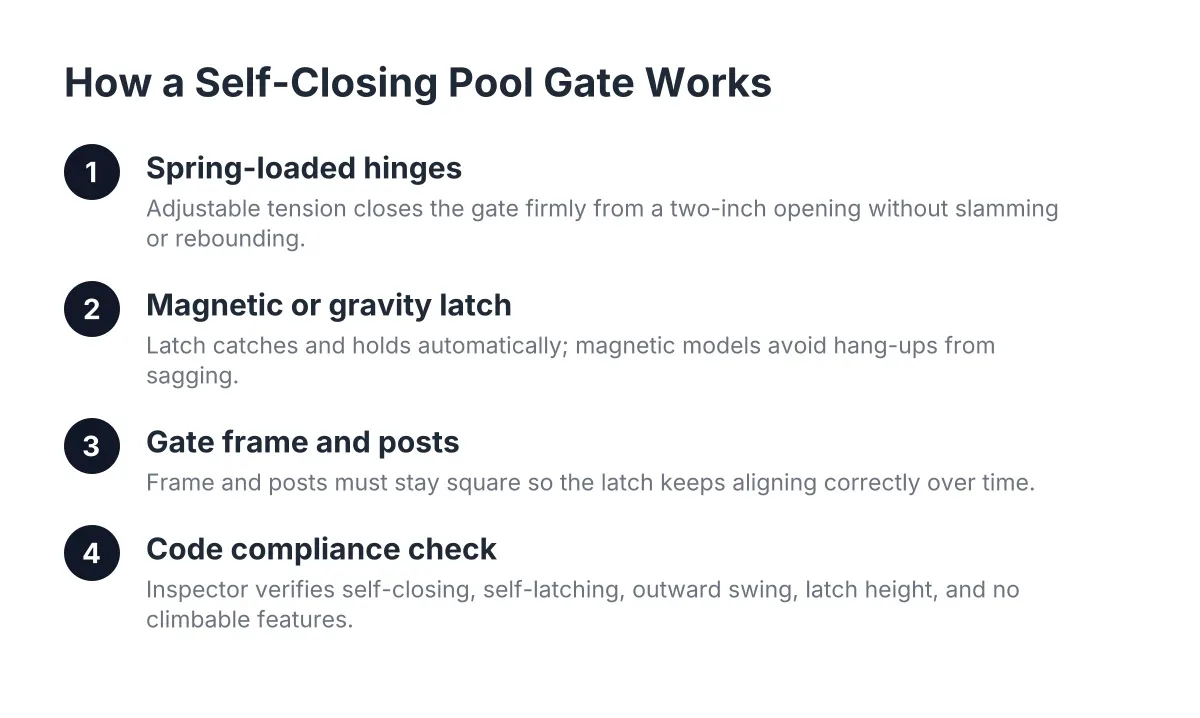
A self-closing pool gate is a simple system with three parts, and all three have to be matched to each other.
Spring-loaded hinges
The hinges do the closing. Most pool gates use adjustable spring hinges; the common style on aluminum and vinyl pool gates is a self-closing safety hinge with tension you can dial up or down. Too little tension and the gate stalls before the latch catches. Too much and the gate slams, bounces off the strike, and sits ajar. The right setting closes the gate firmly from a two-inch opening without rebounding.
Hinge quality matters more on a pool gate than anywhere else on the property. Cheap spring hinges lose tension in Florida heat and humidity within a season or two. Heavier-duty self closing pool gate safety hinges, the polymer-and-stainless style widely used on pool enclosures, hold tension longer and resist rust from chlorinated splash and afternoon rain.
The magnetic or gravity latch
The latch does the holding. Most code-compliant pool gates use a magnetic latch mounted high on the gate post. A magnet pulls the latch pin into place the instant the gate swings home, so there is no mechanical click that can hang up. The release knob sits on top, out of a toddler's reach. Some models add a key lock, which turns a self-latching gate into a self locking pool fence gate when you want the pool area fully secured.
Gravity latches work too, but they are less forgiving. If the gate sags even slightly, the latch arm misses the catch. In Ocala soil, gates sag. More on that next.
The gate frame and posts
The frame and posts do the aligning. A gate can have perfect hinges and a perfect latch and still fail because the posts moved. On vinyl pool gates, a reinforcing channel inside the gate uprights makes a real difference; it gives the hinge and latch screws solid material to bite into, so the frame does not loosen and rack over time. On aluminum gates, a welded frame holds its shape better than a screwed-together one.
Why Ocala's Soil and Weather Are Hard on Pool Gates
This is where local conditions matter more than any product review. Ocala sits on sandy, shifting soil. A gate post set like a standard fence post, with a shallow footing in loose sand, will lean within a year or two. When the post leans, the gate sags. When the gate sags, the latch stops catching, and your self-latching gate becomes a gate that swings shut and hangs open a half inch. That half inch is a failed inspection and, worse, an open path to the pool.
The fix is in the install, not the hardware:
- Deeper, wider concrete footings on gate posts. Gate posts carry dynamic load, not just the weight of a panel. In sandy soil they need more concrete than line posts.
- Heavier posts at the gate opening. A thicker-wall aluminum post or a reinforced vinyl post resists the constant pull of spring hinges.
- Correct gate width. Wider gates leverage more force on the hinge post. Keeping the pedestrian gate at a standard width and adding a separate double gate for equipment access keeps each opening reliable.
- Hardware rated for outdoor pool use. Stainless or polymer hinge and latch bodies shrug off humidity and chlorine. Plain steel hardware rusts, stiffens, and stops closing.
Heavy seasonal rain adds its own problem. Water pooling at the base of a gate post softens the soil and accelerates leaning. Grading the gate area so water drains away, or setting the gate on a slight rise, protects the footing. On properties with dogs that dig, a continuous concrete curb poured under the fence line also blocks the gap-under-the-gate problem that inspectors flag.
For acreage owners outside Ocala, say a horse property in Marion Oaks with a pool near the house, the same rules apply, with one addition. The pool barrier must be its own four-sided enclosure. A perimeter ranch fence or no-climb paddock fence around the property does not count as a pool barrier, even if it is tall and sturdy. The pool needs its own compliant fence and its own self-closing pool gate, separate from the farm fencing.
Choosing a Self-Closing Pool Gate That Matches Your Fence
The gate should match the barrier around it, both in material and in look. Here is how the common options compare for a self closing pool fence in Central Florida.
Aluminum. The most common choice for permanent pool fencing in Ocala, and for good reason. It does not rot or rust through, the open-picket style keeps sight lines to the pool, and welded gates hold alignment well. Self-closing hinges and magnetic latches bolt on cleanly. If you want the pool area to look finished rather than fenced-in, aluminum is usually the answer.
Mesh removable fencing. Popular with families who want a barrier they can take down for parties once the kids are older. Quality mesh systems come with self-closing, self-latching gates and can meet code. The trade-off is permanence; posts sit in sleeves, and the system depends on correct tension. Mesh works well as a second interior barrier inside a larger yard fence.
Vinyl. A vinyl fence gives privacy around the pool and handles humidity well. The gate is the weak point; vinyl gates need internal reinforcement to keep hinges and latches tight. A reinforced vinyl gate with quality spring hinges meets code and lasts. An unreinforced one sags.
Chain link. A chain link fence is the budget path to a compliant barrier and is common on older Ocala properties. Code requires small mesh openings on pool barriers so the fence is not climbable, and the gate still needs self-closing hinges and a high latch. It is functional rather than attractive, but it passes when built right.
There is no single best material for every yard. A privacy-focused family on a small lot and an acreage owner with long sight lines will land on different fences, and an HOA may narrow the choices further. What never changes is the gate hardware standard.
A Hypothetical Inspection Week in Ocala
Suppose a family in a newer development off Maricamp Road just finished a pool build. The pool contractor is done, the final inspection is scheduled for Friday, and the existing wood fence encloses the backyard. The parents assume the yard fence is enough.
In that scenario, three things typically get flagged. First, the existing fence has its rails facing into the yard, which is climbable from the pool side of the barrier logic, so the barrier orientation fails. Second, the yard gate has a plain latch at waist height, reachable by any three-year-old. Third, the gate swings inward toward the pool and does not close on its own.
The fix is not always a whole new fence. Often it means converting the existing gate: new self-closing hinges, a magnetic latch mounted at the required height, rehanging the gate to swing away from the pool, and resetting the hinge post in a proper concrete footing. Sometimes it also means adding an interior section of aluminum or mesh pool safety fence to create a true four-sided enclosure between the house and the water. A fence company that works with Marion County inspections regularly can tell you which path is cheaper before you spend anything, which is the whole point of getting an estimate before inspection week instead of after a failed one.
Cost factors for a gate conversion come down to a few things: whether the posts need to be reset in concrete, the hardware grade, whether the gate frame needs reinforcement or replacement, and whether the swing direction change requires moving the latch post. None of those are exotic, and all of them are cheaper than a re-inspection cycle or a second fence.
Keeping Your Self-Closing Pool Gate Working After the Inspection
Passing inspection is day one. The gate has to keep closing on its own for years, through summer storms, sandy soil movement, and daily use. A short seasonal routine keeps it honest:
- Test the two-inch close. Open the gate two inches and let go. It should close and latch fully. Do this monthly during swim season. This single test catches most failures early.
- Check hinge tension each spring. Spring hinges lose tension over time, and Florida heat speeds that up. Most self-closing hinges adjust with a simple tensioning tool or screwdriver.
- Look at the latch alignment. If the latch pin is scraping the catch or missing it high or low, the gate is sagging or a post is leaning. Catch it early and it is a hinge adjustment; catch it late and it is a post reset.
- Clear the latch of sand and debris. Wind-blown sand works into magnetic latch bodies. Rinse and work the mechanism a few times.
- Keep climbables away from the fence. Patio chairs, planters, and toy bins against the barrier defeat the latch height requirement in seconds.
- Never prop the gate. A propped gate is no gate. If the household keeps propping it for pool access, the gate placement is wrong; move the gate, do not disable it.
A note on honesty here: even a perfect barrier is one layer, not a substitute for supervision. The Florida Department of Health's layers-of-protection approach exists because no single measure is foolproof. A 2025 peer-reviewed study indexed on PubMed estimated that proper pool isolation fencing and consistent life jacket use together could prevent 348 U.S. drowning deaths and $4.5 billion in costs annually. The fence and gate buy you time and remove the most common failure, which is a door or gate left open. They do not replace eyes on the water.
When to Repair the Gate and When to Rebuild the Barrier
If your gate was flagged, the decision usually comes down to the condition of the posts and frame. A sound gate with worn hardware is a straightforward fence repair: new hinges, new latch, swing correction, done in an afternoon. A sagging gate on a leaning post needs the post reset in concrete, which costs more but fixes the root cause. Additionally, a rotted wood gate, a cracked unreinforced vinyl gate, or a barrier with climbable rails facing the wrong way is usually a rebuild of that section.
Two situations call for a professional rather than a weekend fix. First, anything tied to a pending pool permit or a failed inspection; guessing wrong means paying twice, and local inspectors check specific details that vary by jurisdiction. Second, gate posts in soft or recently disturbed soil, common around new pool builds where the yard was excavated. Setting a gate post that will stay plumb in that ground is a judgment call that benefits from someone who sets posts in Ocala sand every week.
The gate is the one part of your pool barrier that has a job to do every single day. Spend your attention and your budget there first, keep the hinges tensioned and the latch clean, and the rest of the fence mostly takes care of itself.
If you need pool safety fence installation, Ocala Fence Builders can help.
Prefer to talk it through? Call (352) 670-3374 — a quick call is usually the fastest way to get a straight answer for your situation.