Chain Link Fence vs. Vinyl: Which Holds Up in Ocala Humidity and Rain?
If you are fencing a pool in Ocala, the vinyl pool fence question comes up fast: should you install vinyl-coated chain link, solid vinyl fencing, or something else? Both can pass a Florida pool barrier inspection when built right. Both handle our humidity and summer rain differently. This guide walks you through the decision step by step, so you pick a fence once, pass inspection the first time, and do not pay for the job twice.
A quick note on why this matters here. Ocala gets heavy seasonal rain, long stretches of humidity, and sandy soil that shifts under fence posts. A fence that works fine in a dry climate can rust, sag, or lean here within a few seasons. The steps below are ordered the way a fence company would actually work the problem with you.
Step 1: Confirm What the Pool Inspection Actually Requires
Start with the code, not the catalog. Florida pool barrier rules set a minimum fence height, limits on gaps and climbable features, and a requirement that gates be self-closing and self-latching with the latch positioned out of a small child's reach. Your county inspector checks all of it. Material is mostly your choice; chain link, vinyl, aluminum, and mesh can all comply when the height, gap, and gate details are correct.
The layout matters as much as the material. According to the Centers for Disease Control and Prevention, a four-sided isolation fence that separates the pool from the house and yard reduces a child's risk of drowning by 83% compared to three-sided fencing that uses the house as one barrier. If you are deciding where the fence goes, that is the strongest argument for fencing the pool itself, not just the backyard.
Height alone is not the whole story either. A National Institutes of Health study found children as young as four climbed a five-foot fence in a median of 17 seconds. That is why inspectors look at climbability, mesh size, and horizontal rails a kid can use as a ladder, not just the tape measure.
Step 2: Compare Vinyl Pool Fence Options
Here is the core trade-off. Vinyl-coated chain link is galvanized steel mesh with a bonded PVC layer, usually black or green. Solid vinyl fencing is PVC panels with no metal exposed at all. In Ocala's humidity, the difference shows up over years, not weeks.
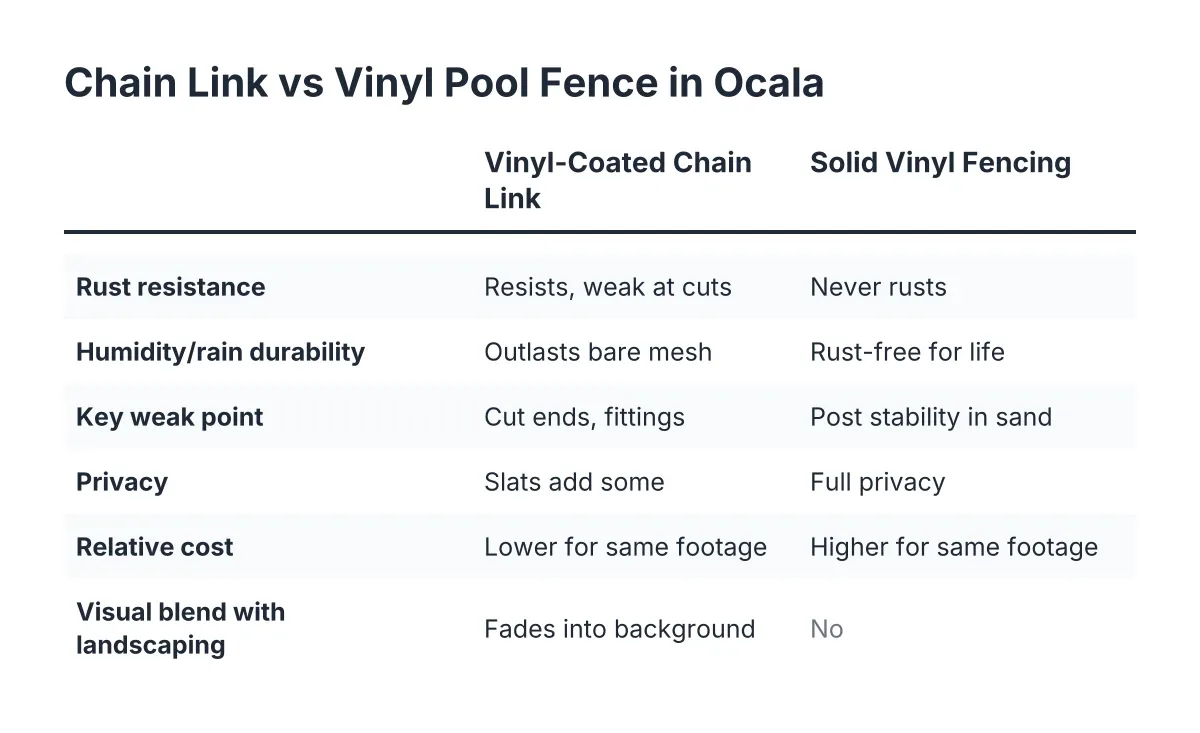
Vinyl-coated chain link resists rust far better than bare galvanized mesh because the coating seals the steel away from moisture. The weak points are cut ends, scratches, and fittings where bare metal meets humid air. A good install minimizes exposed cuts and uses coated fittings to match. For pool enclosures, black vinyl chain link also reads as a backdrop; it fades visually against landscaping instead of looking like a cage, which matters to a lot of pool owners.
Solid vinyl fencing does not rust at all, and it resists rot and fading in a way wood never will here. It is still PVC, so it can soften or burn in extreme heat such as a fire, but Ocala rain and humidity are not a threat to it. The structural question with vinyl is the posts. Vinyl posts are the foundation of the whole system, and in sandy, shifting soil they need deep, properly set footings. At corners and ends, heavy-duty posts with thicker walls carry the extra load; in tough spots, installers can sleeve the vinyl post over a reinforced metal pipe for added strength.
For privacy, the gap narrows. Chain link fence vinyl privacy slats, sometimes called vinyl inserts or strips, can be woven into the mesh to block sightlines. They help, but they never match the full privacy of solid vinyl panels, and inspectors still evaluate the underlying mesh for climbability.
How a Vinyl Pool Fence Ages in Ocala Weather
Expect vinyl-coated chain link to outlast bare galvanized mesh here by a wide margin, with the coating doing most of the work against humidity. Expect solid vinyl to stay rust-free for its life, with post stability in sandy soil as the thing to watch. Wood is the material that struggles most with our rain cycle, which is why many Ocala pool owners skip it for the barrier itself.
Step 3: Price the Job by Cost Factors, Not a Number Off the Internet
Chain link fence vinyl cost and solid vinyl cost both move with the same handful of factors, and national per-foot figures rarely match an Ocala quote. When you compare chain link fence vs vinyl cost, look at what drives the price rather than a single number:
- Linear footage and fence height, since pool code sets the minimum height
- Material grade, such as mesh gauge and coating on chain link, or panel thickness on vinyl
- Number of gates, because self-closing and self-latching pool gate hardware adds cost per gate
- Post setting conditions, since sandy or shifting soil can call for deeper or wider concrete footings
- Terminal and corner posts, which are heavier than line posts on both systems
- Tear-out of an old fence, permit fees, and privacy slats if you add them to chain link
In general, vinyl-coated chain link lands below solid vinyl for the same footage, and privacy slats narrow that gap. Ask any fence company to break the estimate into these line items so you can compare quotes on the same basis.
Step 4: Get the Gate Right, Because That Is What Inspectors Flag
Gates fail more pool inspections than fence lines do. Suppose a family in southeast Ocala just finished a pool build and the county inspector flags the gate: it swings toward the pool, the latch sits too low, and it does not close on its own. In that scenario the fence itself was fine; the gate hardware was the whole problem, and fixing it meant new hinges, a relocated latch, and rehanging the gate to swing outward.
Plan every gate to open away from the pool, close itself from any open position, and latch automatically at the required height. On chain link, that means spring hinges and a gravity or magnetic latch rated for the gate frame. On vinyl, it means hardware matched to the panel weight, because a sagging vinyl gate stops self-latching within a season. Ocala's sandy soil makes gate posts the most likely part of any fence to shift, so gate posts deserve the deepest footings on the job.
Step 5: Decide What to DIY and When to Call a Pro
A capable homeowner can handle some of this. You can measure the layout, mark the property line, check your HOA rules, and install privacy slats in an existing chain link fence yourself. Chain link fence installation diagrams and guide PDFs cover the mechanics well for a simple yard fence.
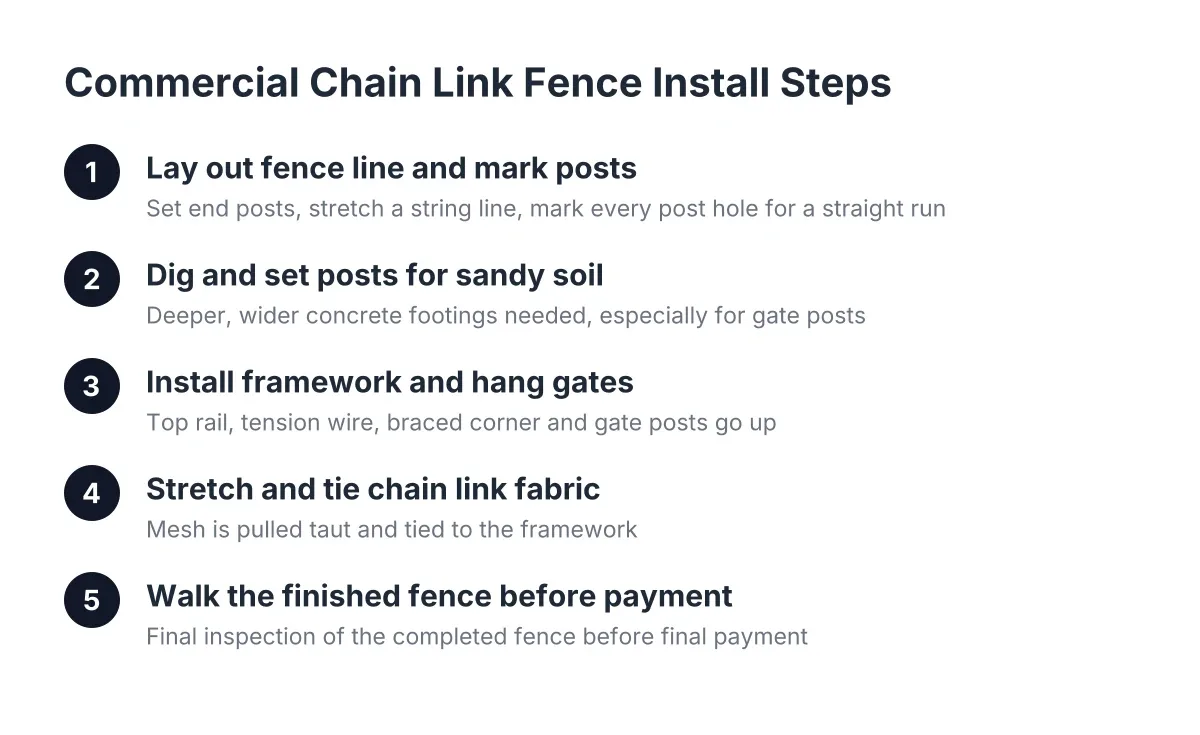
A pool barrier is a different job. The fence has to pass a county inspection tied to your pool permit, and a failed inspection means delays and rework. Professional chain link fence installation also solves the parts DIY guides gloss over: stretching the mesh to proper tension so it does not sag, matching fence ties to the pipe diameter, setting posts deep enough for sandy soil, and tuning self-latching gate hardware so it passes on the first visit. If your timeline is driven by a closing date or a permit deadline, that first-try pass is worth more than the labor savings.
Call a professional now if you see any of these:
- An inspector has already flagged your fence or fence gate as non-compliant
- Posts lean or gates sag after heavy rain
- You are unsure where your property line sits relative to the planned fence
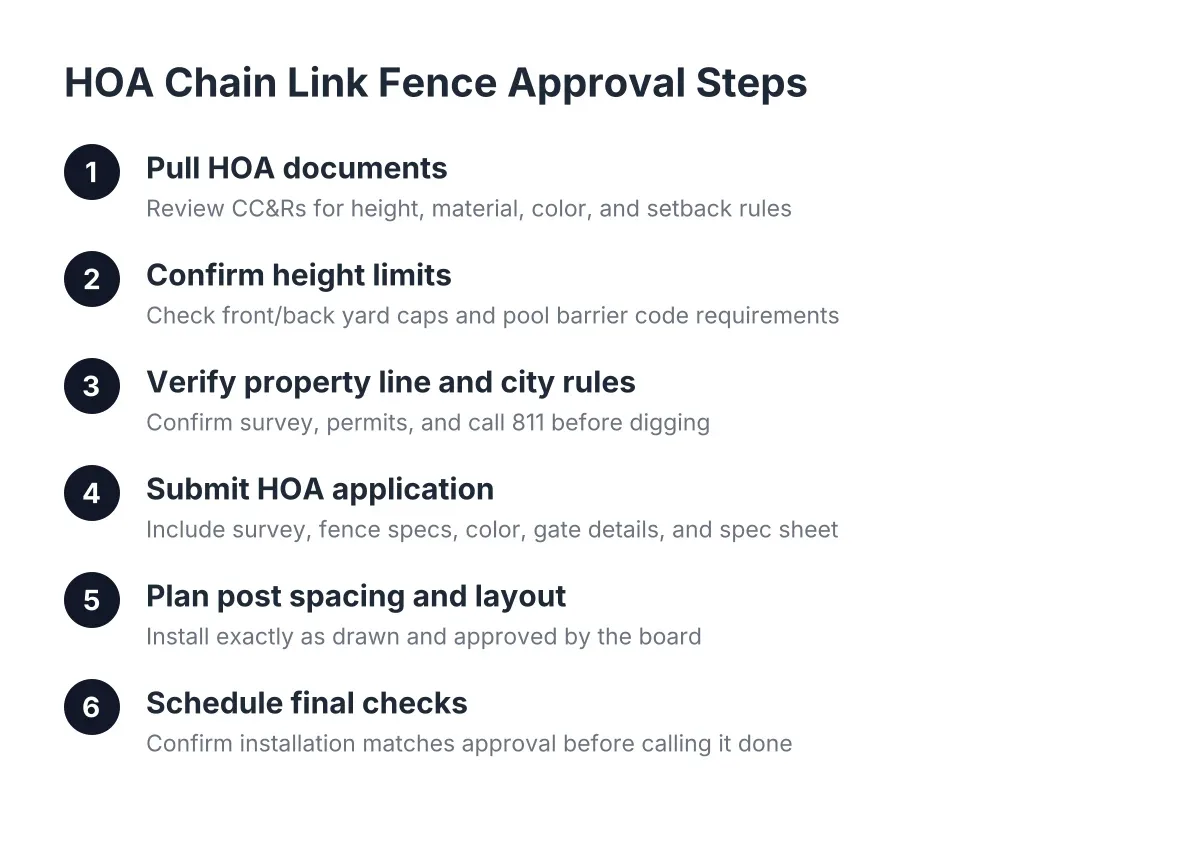
- Your HOA has rules about fence height, color, or material
That last one is not rare. According to Forbes, fencing shows up in 23% of HOA violation notices, tied for second place among all violation types. A quick check of your HOA documents before the posts go in costs nothing; moving a finished fence costs plenty.
Step 6: Choose a Fence Company That Knows Florida Pool Code
When you search for chain link fence installation near me or pool fence installers, the results are mostly provider listings, so you will be comparing companies rather than articles. Three questions sort them fast:
- Have you installed pool barriers that passed inspection in Marion County, and what does the inspector check here?
- How deep do you set posts in sandy soil, and what do you do differently at gates and corners?
- Does the estimate itemize gates, hardware, footage, tear-out, and permit handling?
A fair quote lists those items separately and states the mesh gauge and coating for chain link, or the panel and post specs for vinyl. Vague lump-sum quotes make it impossible to compare, and they hide the gate hardware that your inspection depends on. Timelines vary with permit review and material availability, so ask each fence company for a realistic schedule rather than a promise.
One honest caveat: no article can confirm your specific barrier complies, because county interpretation and site conditions vary. Have your plan reviewed against the current code before anyone digs, and treat the inspector as the final word.
The Bottom Line for Ocala Pool Owners
Both materials can protect your pool and pass inspection. Chain link fence vinyl coating gives you the lowest-cost compliant barrier that stands up to Ocala humidity, with black mesh that disappears visually into the yard. Solid vinyl fencing costs more, delivers full privacy, and never rusts, provided the posts are set to handle our sandy soil. Either way, the gate hardware and the post footings decide whether you pass inspection the first time.
If you are working against a pool permit, a closing date, or an inspection notice in Ocala or the surrounding area, Ocala Fence Builders can walk your property, explain the code requirements for your layout, and give you an itemized estimate for chain link, vinyl, or aluminum pool fencing. Reach out to schedule a site visit before your inspection date gets close.
If you need chain link fence installation, Ocala Fence Builders can help.
Prefer to talk it through? Call (352) 670-3374 — a quick call is usually the fastest way to get a straight answer for your situation.