Commercial Chain Link Fence Installation in Ocala: A Step-by-Step Guide for Businesses
A commercial chain link fence is still the most practical way for an Ocala business to secure a yard, lot, or storage area without spending what a solid-panel fence costs. This guide walks through the commercial fence installation steps step by step, so you know what a fence company should be doing on your property, what drives the estimate, and where the job goes wrong in Ocala's sandy soil. It handles heat, rain, and humidity better than wood, it does not block sightlines for cameras or patrols, and metal fencing in general remains the default for security sites; metal products held a 47.2% share of the fencing market in 2025, according to Mordor Intelligence.
Even if you plan to hire the work out, understanding these commercial fence installation steps helps you compare bids. Two quotes can look identical on paper and describe two different fences. The post size, the setting depth, and the gauge of the mesh decide how long the fence stands, and none of that shows up in a one-line price.
Understanding Commercial Fence Installation Steps
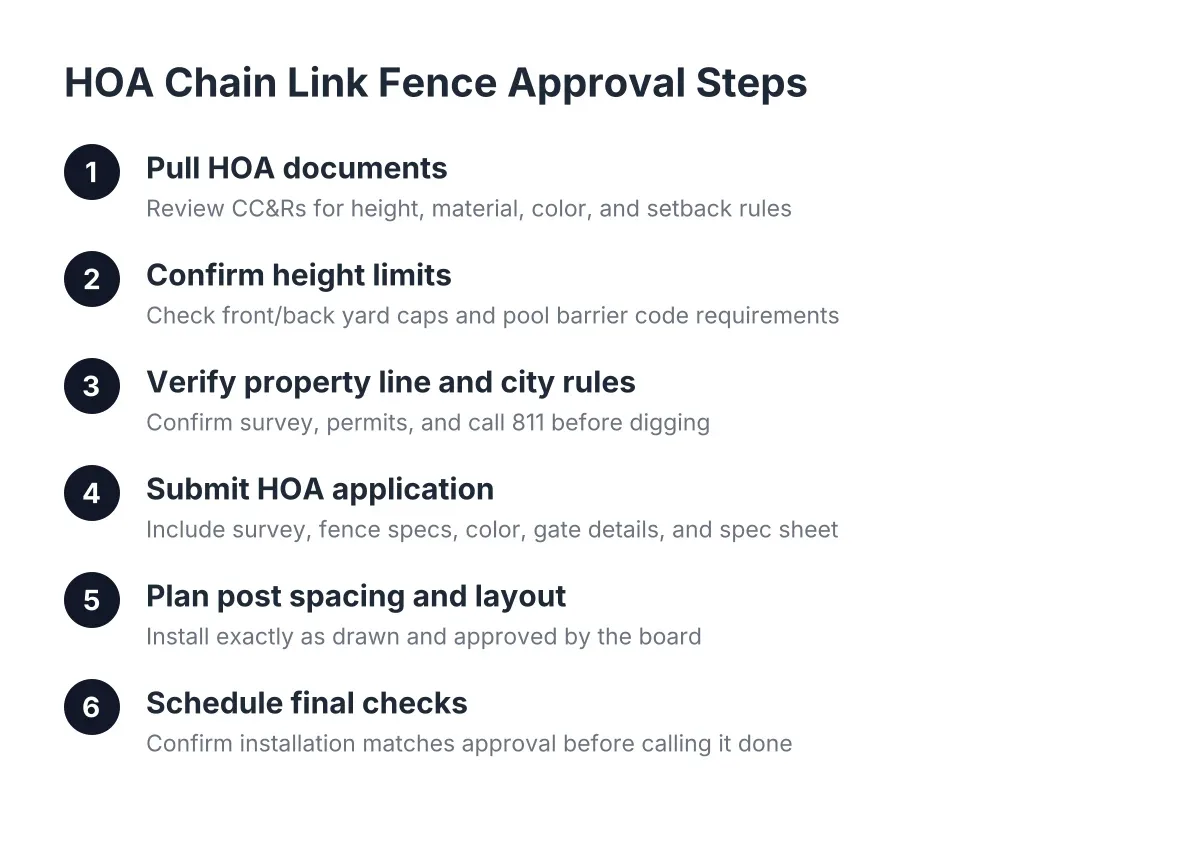
Before anyone digs, confirm where the fence can legally go. For a commercial property in Ocala, that usually means a survey or recorded plat to locate the property line, a check with the City of Ocala or Marion County on permit requirements, and a utility locate call before digging. Building even a few inches onto a neighboring parcel can force a tear-out later.
In addition, check any site-specific rules. Business parks and some mixed-use developments have covenants that limit fence height or placement, much like an HOA does for residential fencing. Fencing disputes are common enough that a Forbes-reported survey found fencing is a factor in 23% of HOA violation notices. Commercial covenants work the same way; read them first.
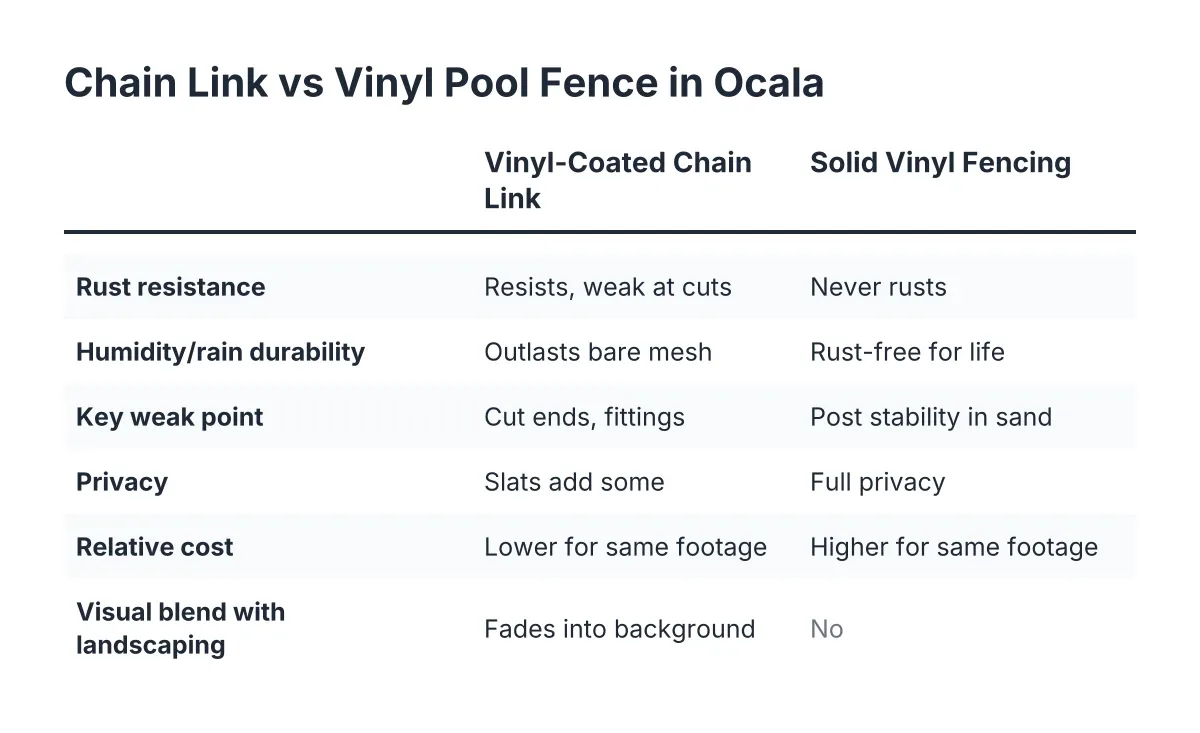
If the fence will enclose a pool area, such as at a hotel, apartment complex, or club, the rules tighten. A four-sided isolation fence that separates the pool from the building and yard reduces a child's drowning risk by 83% compared to three-sided fencing, according to the Centers for Disease Control and Prevention. Pool fence layouts have their own code requirements, and that portion of the job should be designed to meet them, not just to match the perimeter fence.
Choosing Commercial Fence Installation Specifications and Steps
Commercial chain link fence specifications come down to four decisions: fence height, mesh gauge, framework size, and coating. Common commercial heights run from six to eight feet or more, often topped with barbed wire where code allows. Heavier gauge mesh resists cutting and sagging. Larger-diameter, thicker-wall posts carry taller fabric and survive gate traffic.
Here is what separates a commercial spec from the light residential material sold at big-box stores:
- Heavier mesh gauge: thicker wire that resists cutting, climbing damage, and impact
- Larger commercial chain link fence post sizes: bigger diameter terminal and line posts with thicker pipe walls
- Full framework: top rail, tension wire or bottom rail, and braced corner and gate posts
- Coating matched to the site: galvanized for most lots, vinyl-coated where appearance matters or salt exposure is a concern
- Gate hardware rated for daily use, not occasional backyard access
Height alone is not security. In a study on pool fence effectiveness, four-year-old children took a median of just 17 seconds to climb a five-foot fence, according to the National Institutes of Health. For a commercial site, that means pairing adequate height with small mesh openings, no horizontal footholds on the outside face, and a top treatment suited to the risk.
One caution on shopping by price. Searches for cheap fence installation turn up the lowest bid, but the cheapest contractor often installs lighter material set in shallower holes. The fence fails years early, and rebuilding it costs more than the difference would have cost upfront. Compare the spec sheet, not just the bottom line.
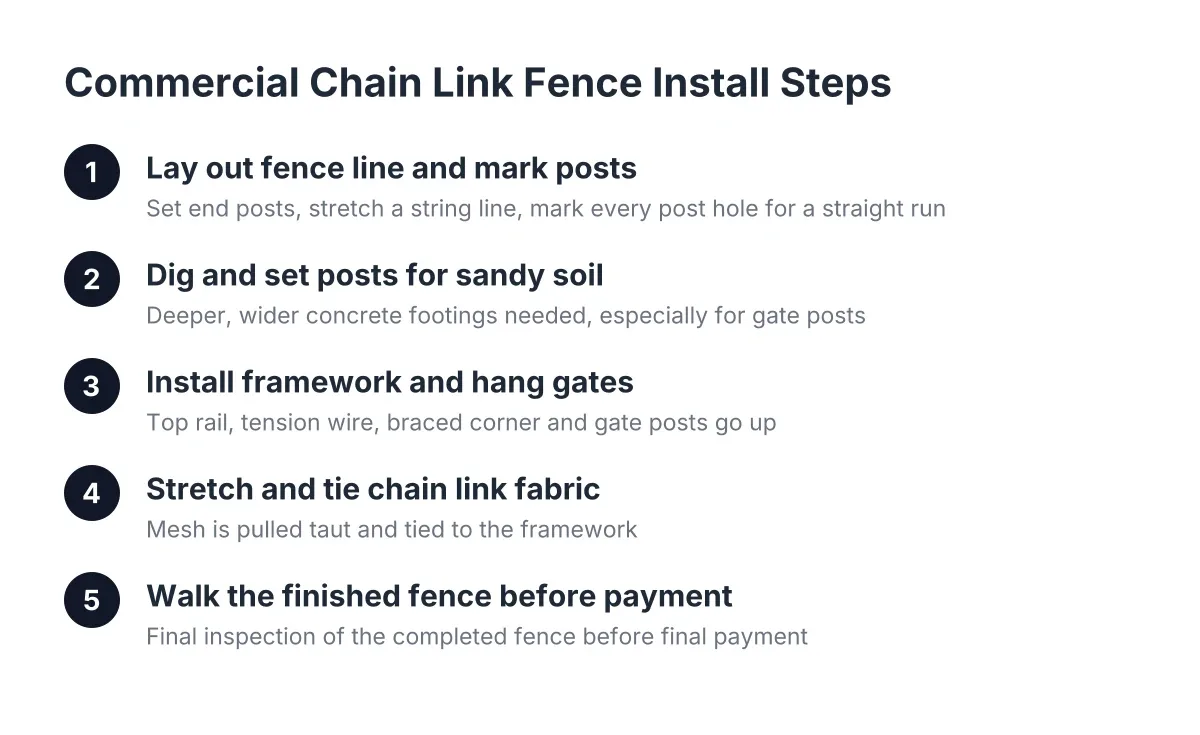
Step 3: Lay Out the Fence Line and Mark Post Locations
Next, the crew sets the two end posts of each run first, then stretches a string line between them. Every post hole gets marked along that string so the finished fence runs dead straight. Skipping the string line is how fences end up with a visible wave in them, which matters on a commercial frontage that customers see every day.
Post spacing follows the fence design, typically set at even intervals with the gate openings laid out first. Gates control the layout because a commercial fence installation involves posts placed exactly where gate openings require them; everything else adjusts around that. On sites that mix full and shortened sections, a careful installer puts the cut sections in the least visible stretch and keeps full, even panels along the street face.
Step 4: Dig and Set Posts for Ocala's Sandy Soil
This step decides whether the fence stands straight in ten years. Ocala sits on sandy, shifting soil, and sand does not grip a post the way clay does. Terminal posts, corner posts, and gate posts need deeper, wider concrete footings here than a generic chain link fence installation diagram or installation guide PDF will show, because those documents assume firm soil.
Gate posts deserve the most attention. A sagging gate is the most common failure on commercial lots in this area, and it almost always traces back to a gate post footing that was sized for the fence, not for the gate swinging on it. Heavy seasonal rain soaks the sand, the footing rocks, and the gate drags within a few years.
Posts get set in concrete, plumbed with a level, and aligned to the string line. Then the concrete cures before any tension goes on the framework. Rushing this step, stretching fabric against green concrete, pulls posts out of plumb before the job is even finished.
Step 5: Install the Framework and Hang the Gates
Once the footings cure, the crew installs the top rail through the line post caps, adds tension wire or bottom rail, and braces the corner and gate posts with diagonal struts and truss rods. Bracing matters because the terminal posts absorb the full pull of the stretched fabric. An unbraced corner leans over time; a braced one does not.
Gates hang at this stage, before the fabric goes on, so the opening can be checked and adjusted. For drive gates, hinges and latches should be sized for daily commercial traffic. If the design includes an automated slide or swing gate, the operator pad and electrical rough-in happen now as well.
Step 6: Stretch and Tie the Chain Link Fabric
Now the mesh goes up. The crew unrolls the fabric along the fence line, attaches one end to a terminal post with a tension bar and tension bands, and pulls it tight with a fence stretcher. Properly stretched fabric is snug enough that it does not flex much when pressed, but not so tight that it distorts the mesh pattern.
After stretching, the fabric gets tied to the top rail and line posts with fence ties, spaced at regular intervals. Ties come in different lengths matched to the pipe diameter, which is one of those small commercial chain link fence parts that signals whether an installer knows the trade. Loose or missing ties let the fabric rattle, sag, and separate from the frame in wind.
Step 7: Walk the Finished Fence Before Final Payment
Finally, walk the full line with the installer. Check these points:
- Posts are plumb and the line runs straight against a sightline
- Fabric is tight, with no ripples, and the bottom gap is even
- Gates swing or slide freely, latch cleanly, and do not drag
- Corner and gate posts are braced, and all caps and ties are in place
- Concrete is finished at grade so water sheds away from the posts
A fair contract spells out the spec: post sizes, mesh gauge, footing depth, gate hardware, and who handles the permit. If a bid cannot answer those questions, you are not comparing the same fence.
What Drives Commercial Chain Link Fence Cost in Ocala
The cost of a commercial chain link fence depends on linear footage, fence height, mesh gauge, framework size, coating type, the number and size of gates, and site conditions. Long straight runs on clear, level ground price lower per foot. Gates, corners, slopes, tree roots, old fence removal, and automation push the estimate up.
For example, suppose a landscaping supply yard off Highway 441 needs a six-foot galvanized perimeter with one wide drive gate and a walk gate. The straight runs are the easy part of that estimate. The drive gate, its oversized posts and footings, and the demolition of a rusted old fence are where most of the variation between bids will come from. Timeline follows the same logic; a clear site with simple runs goes faster than one with demolition, rock, or access problems, and cure time for gate post concrete sets the floor on how fast any honest crew can finish.
This same logic applies at acreage scale. An owner fencing a storage area or equipment yard on a horse property outside Ocala is pricing the same variables, just across longer runs where footage dominates the number.
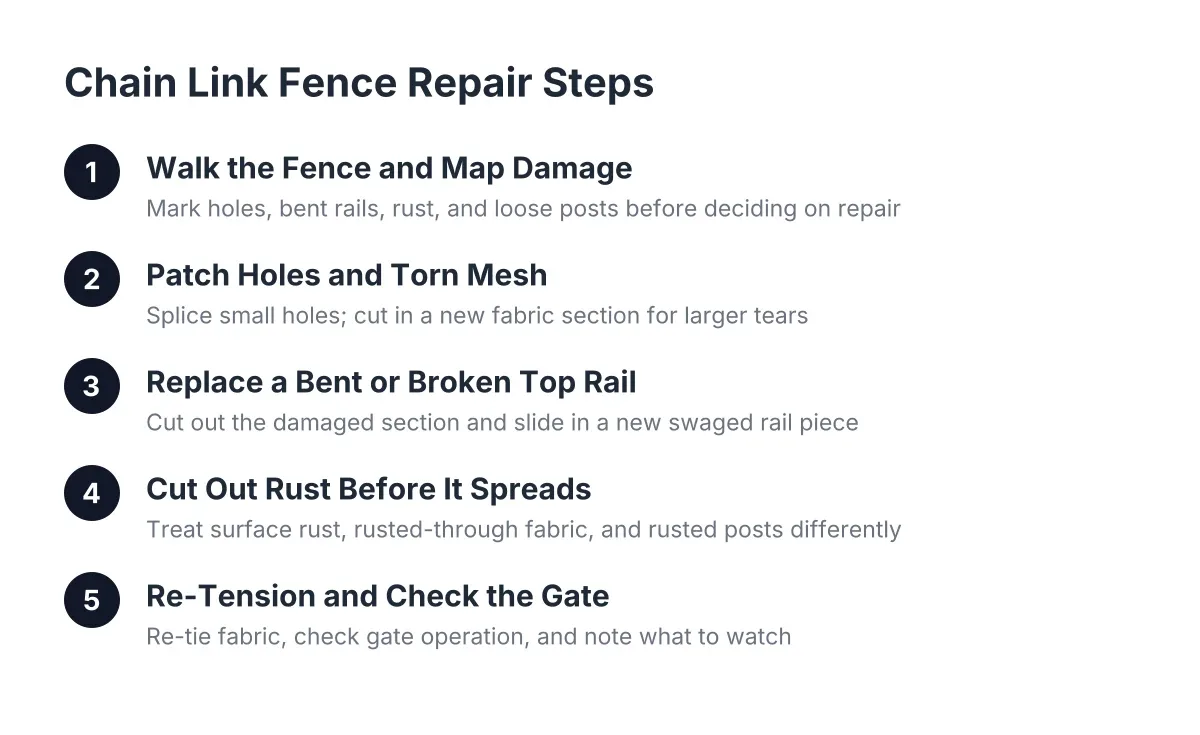
When to Hire a Pro Instead of Doing It Yourself
Hire a professional for any commercial chain link fence over six feet tall, any job with drive gates, and any fence tied to code requirements such as pool enclosures. A capable owner can handle a short, low interior divider with rented tools. However, fabric stretching, gate post footings in sand, and permit compliance are where DIY jobs fail, and a leaning gate post means digging out and repouring concrete, not tightening a bolt. Call a fence repair pro now if an existing fence has leaning terminal posts, a dragging gate, or fabric pulling away from the frame; those get worse through every rainy season.
One honest trade-off: chain link will never give you privacy or the curb appeal of a wood fence or vinyl fence. If the goal is screening a storefront patio rather than securing a yard, chain link with slats is a compromise, and a different material may serve better. A site visit settles that question faster than any guide can.
Getting a Straight Answer on Your Fence
A good estimate for commercial fencing in Ocala should name the post sizes, mesh gauge, footing depth, gate hardware, and permit responsibility in writing. Ask every bidder three questions: how deep do the gate post footings go in this soil, what gauge is the fabric, and who pulls the permit. The answers tell you more than the price does.
Ocala Fence Builders installs and repairs chain link, vinyl, wood, and pool fencing for businesses and homeowners across Ocala and the immediately surrounding areas. If you are pricing a commercial perimeter, a gate replacement, or a full tear-out and rebuild, reach out for an estimate based on your actual site, soil, and layout.
If you need chain link fence installation, Ocala Fence Builders can help.
Prefer to talk it through? Call (352) 670-3374 — a quick call is usually the fastest way to get a straight answer for your situation.