Aluminum Privacy Fence Blocking: Views, Sound, and Wind in Ocala, FL
Most people picture an aluminum fence as an open picket design you can see straight through. That works for a pool fence or a front yard, but it does nothing to block a view. If you are weighing an aluminum privacy fence blocking sightlines, cutting down sound are the two jobs you actually care about, and aluminum can do both when the panels are built for it. This guide explains how aluminum privacy fencing works, what it blocks and what it does not, and how it behaves in Ocala's wind, rain, and sandy soil.
It is written for two kinds of readers. The first is a homeowner whose wood fence came down in the last storm and who is deciding whether to rebuild in wood or switch to something that will not rot or blow apart the same way. The second is a commercial property manager who needs a perimeter that screens a storage yard or equipment area without the maintenance load of wood.
What an Aluminum Privacy Fence Actually Is
An aluminum privacy fence uses solid or near-solid panels instead of the spaced pickets most people associate with aluminum fencing. Manufacturers build these panels in a few ways. Some use wide vertical slats set edge to edge. Others run horizontal boards with no gap, similar to a modern wood fence but in powder-coated metal. A third style uses louvered slats angled so you cannot see through at eye level.
The frame is the same rust-resistant aluminum used in standard picket fences. The difference is the infill. Instead of air between pickets, you get a solid face from rail to rail. That changes what the fence does. A picket fence marks a boundary. A privacy panel blocks the view across it.
Panel heights for privacy styles usually run taller than pool and garden fences, since a panel you can see over does not give much privacy. Full-privacy aluminum fence panels come as complete units that attach to posts, which matters later when we talk about storm repair.
Privacy Styles for Aluminum Fence Blocking Sightlines
When you look at catalogs or talk to an aluminum fence supplier, the privacy options generally fall into four groups:
- Full-privacy vertical panels. Solid slats with no gaps. Maximum view blocking, maximum wind resistance against the face of the fence.
- Semi-privacy panels. Narrow gaps between slats, similar in concept to a shadow box wood fence. You get airflow and partial screening.
- Horizontal board styles. Solid or near-solid horizontal infill. Popular on newer builds and modern remodels. Splice points between boards are covered with a vertical trim strip for a clean finished look.
- Louvered panels. Angled slats that block sightlines at eye level while letting air and some light pass through.
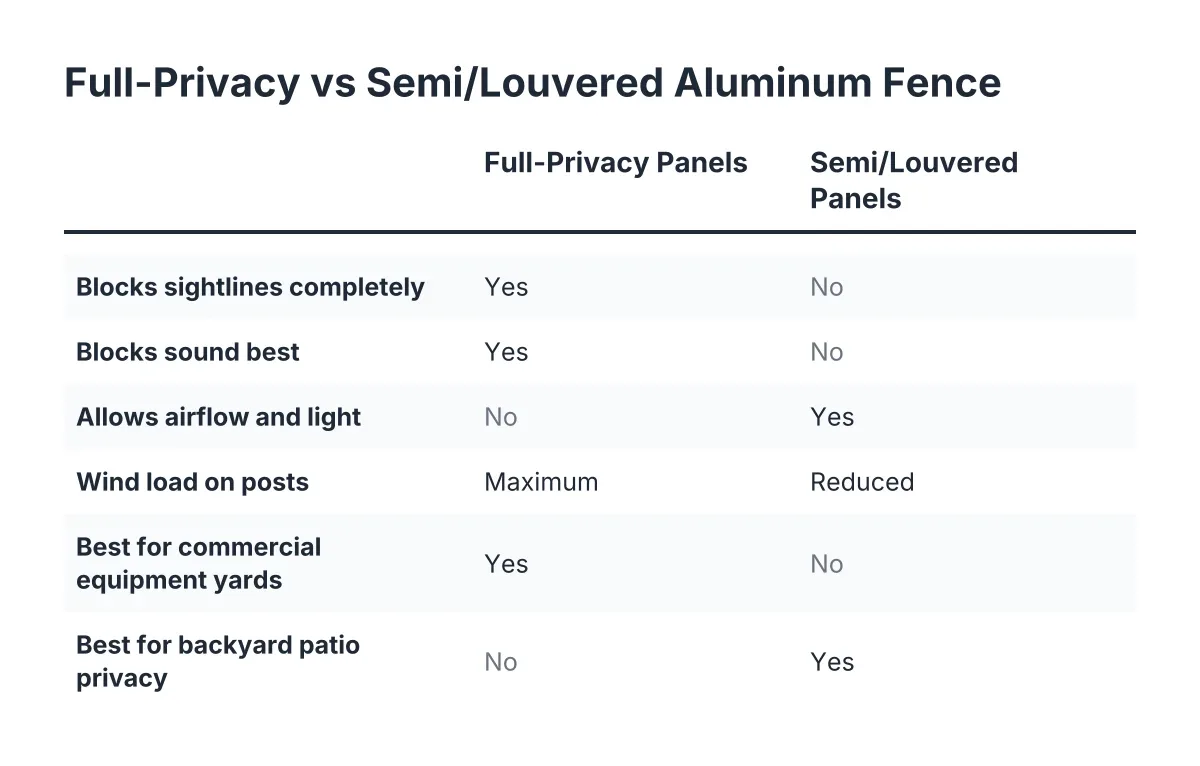
Each style trades something. Full privacy blocks the most but catches the most wind. Louvered and semi-privacy styles breathe but do not block everything. That trade-off drives most of the decisions below.
How Well Aluminum Privacy Panels Block Views
A full-privacy aluminum panel blocks sightlines completely along the fenced run, the same as a solid vinyl fence or a board-on-board wood fence. There are no knotholes, no board gaps that open up as wood shrinks, and no slats that warp apart over time. What you install on day one is what you have in year ten.
That last point is the real difference from wood. A wood privacy fence in Ocala starts solid, then the boards shrink in dry stretches and gaps appear. Aluminum slats do not shrink or cup, so the screening stays consistent through humidity swings and summer heat.
Semi-privacy and louvered styles block differently. Stand directly in front of a louvered panel and you see metal. Stand at an angle and you may catch slivers of the yard behind it. For a backyard patio, that is usually fine. For a commercial equipment yard where you want nothing visible from the street, full-privacy panels are the right call.
Height matters as much as panel style. Privacy at a seated patio height and privacy from a neighbor's second-story window are different problems. No standard fence solves the second one; plan the fence around what you realistically need to screen at ground level.
What Aluminum Privacy Fence Blocking Does for Sound
A solid aluminum privacy fence reduces direct line-of-sight noise, such as road noise from a street at the same grade as your yard. A solid barrier forces sound to travel over or around it, which takes the edge off traffic hum, a neighbor's pool pump, or conversation noise from the next patio. It will not make a loud road silent.
Be realistic here. A fence is a barrier, not soundproofing. Sound bends over the top of any residential-height fence, so you get a noticeable reduction close to the fence and less benefit farther into the yard. Taller solid panels block more than shorter ones. Solid infill blocks more than louvered or semi-privacy infill, since gaps let sound pass straight through.
For most Ocala homeowners, the honest summary is this: an aluminum privacy fence takes a busy-road backyard from distracting to tolerable. If you need serious noise control from a highway, that is an engineering problem beyond what any standard fence company installs, and it is worth consulting an acoustic professional before spending fence money on a sound goal a fence cannot meet.
Wind: The Trade-Off Storm-Damaged Owners Should Understand
If your last fence came down in a storm, read this section twice. A solid privacy fence blocks wind almost completely, and that is exactly why solid fences take the hardest hit in high wind. The panel acts like a sail. Every pound of wind pressure on that solid face transfers to the posts and footings. A semi-privacy or louvered design lets wind pass through the gaps, so the structure carries less load in a storm.
Therefore, the choice is not just about views. It is a structural decision:
- Full-privacy panels give maximum view and sound blocking but put maximum wind load on posts. Post depth, footing size, and post spacing have to be built for that load, especially in Ocala's sandy soil where posts can loosen over time.
- Semi-privacy panels give up some screening in exchange for wind relief. Like a shadow box wood fence, they also look the same from both sides, which keeps neighbors and HOAs happy.
- Louvered panels split the difference. Eye-level blocking stays strong while air moves through the angled slats.
Here is where aluminum has a practical edge after a storm. Aluminum privacy fences are panelized. If a tree limb crushes one section, a crew can replace that panel without rebuilding the whole run, provided the posts held. Compare that to a wood fence where a downed section often means new posts, new rails, and new pickets, with new boards that will not match the weathered ones beside them.
Suppose a homeowner in a 1990s Ocala subdivision lost three sections of a six-foot wood privacy fence in a summer storm, with panels flat in the yard and a dog that needs containing. In that scenario, the repair-versus-replace question usually comes down to post condition. If the wood posts snapped or heaved in the wet sandy soil, rebuilding in wood means paying for new posts anyway. That is the moment many owners price an aluminum privacy fence instead, because the next storm becomes a panel swap rather than another teardown.
Why Aluminum Privacy Fencing Suits Ocala Conditions
Ocala is hard on fences in specific ways: heavy seasonal rain, year-round humidity, sandy and shifting soil, and summer storms. Each one favors aluminum over the materials it competes with.
Humidity and rain are the big ones. Wood absorbs moisture, swells, rots at the ground line, and feeds mold on shaded runs. Powder-coated aluminum sheds water and does not rot, and unlike steel it does not rust when the coating gets scratched. For a privacy fence, which has far more surface area than a picket fence, that maintenance difference compounds. A solid wood privacy fence is a lot of board feet to stain and seal every few years. A solid aluminum fence needs an occasional rinse.
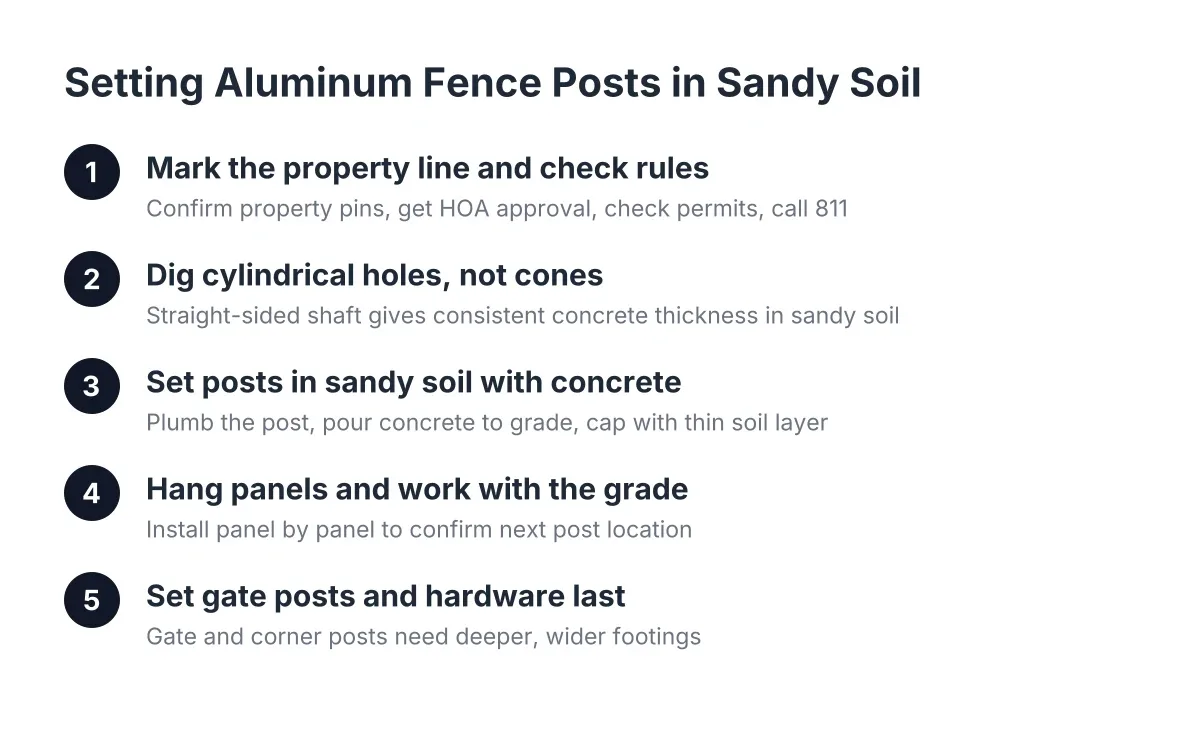
Sandy soil affects posts more than panels. Posts set in loose, wet sand can shift, and a shifted post shows up fast on a solid fence because the panel line breaks visibly. Proper footing depth and concrete sizing matter more for privacy panels than for open pickets, since the wind load is higher. This is a place where installation quality decides how the fence performs, not the material itself.
Gates deserve a mention. Gate sag is a common complaint in Ocala's soil, especially on wood gates that gain weight when wet. An aluminum fence gate stays the same weight in August as it does in January, which keeps hinges and latches aligned longer.
The market reflects this durability logic. According to Mordor Intelligence, metal products including steel and aluminum captured a 47.2% share of the fencing market in 2025, and they remain the default for high-security and industrial sites. The Business Research Company values the global aluminum metal fencing market at $4.93 billion projected for 2026, growing at a 6.9% annual rate. Buyers keep moving toward metal for the same reasons storm-weary Florida owners do.
Blocking Views on Commercial Properties with Aluminum Privacy Panels
Commercial buyers come at privacy from a different direction: liability, security, and appearance from the street. Say a property manager takes over a self-storage facility or an auto lot in Ocala. Chain link secures the perimeter, but everything inside is visible, which invites theft scouting and looks rough from the road. Aluminum privacy panels solve the visibility problem while keeping a rigid metal perimeter.
For commercial work, the decision points shift:
- Screening inventory and equipment. Solid panels keep vehicles, stored goods, and loading areas out of sight from the street and neighboring parcels.
- Durability against contact. Aluminum panels resist the daily abuse of a commercial site better than vinyl, which can crack on impact, and they do not need the repainting cycle of steel in humid climates.
- Appearance requirements. Retail pad sites and offices near residential areas often face design standards. A black or bronze aluminum privacy fence reads as architecture rather than industrial screening.
- Repair logistics. When a vehicle backs into a panel or a storm drops a limb on the line, panelized construction means the damaged section comes out and a matching one goes in, without closing the perimeter for days.
A mixed approach is common on commercial sites: full-privacy aluminum along the street frontage where appearance and screening matter most, and chain link or semi-privacy panels on the back property line where cost control matters more. A fence company that installs both residential fencing and commercial fencing can lay out that split on a site walk.
HOA Rules, Property Lines, and Which Side Faces Out
Privacy fences draw more HOA attention than any other fence type because they change what neighbors see. A Forbes-reported survey found that fencing is a factor in 23% of HOA violation notices, tied with design changes as the second most common issue behind landscaping. Before you order panels, pull your HOA's fence rules and check three things: allowed height, allowed materials and colors, and whether solid fences are permitted at all.
Aluminum privacy fencing tends to clear HOA review more easily than wood for a simple reason: it looks the same from both sides. A standard wood privacy fence has a finished face and a framing face, and most HOAs require the finished side to face outward. Aluminum privacy panels are symmetrical, so the good-neighbor question disappears. Posts are typically set so the panel face reads clean from the street side, which installers plan during layout.
Property lines matter just as much. A privacy fence set even slightly over the line is an expensive mistake to move, and solid fences make encroachment disputes worse because the neighbor loses light and view, not just a strip of grass. Confirm the line before posts go in, and check whether your project needs a permit; requirements in and around Ocala vary by location and fence height as of 2026. When the line is uncertain, a survey costs far less than relocating a fence.
One more note for pool owners considering privacy panels around a pool area. Privacy and pool safety are separate requirements. The CDC reports that a four-sided isolation fence separating the pool from the house and yard reduces a child's drowning risk by 83% compared to three-sided property-line fencing. A tall solid perimeter fence does not replace a code-compliant pool fence layout, and height alone does not stop climbing; an NIH-cited study found four-year-olds took a median of 17 seconds to climb a five-foot fence. Design the pool enclosure to code first, then add privacy where you want it.
Cost Factors for an Aluminum Privacy Fence in Ocala
Aluminum privacy panels cost more than open picket aluminum, and more than a basic wood privacy fence, for reasons you can see in the product. Solid infill uses far more material per linear foot than spaced pickets. The same logic that makes a board-on-board wood fence cost more than a flat-face fence applies here: more material and more labor per foot of fence line.
The main cost factors on an Ocala install:
- Panel style. Full privacy costs more than semi-privacy or louvered, because solid infill is the most material-intensive option.
- Height. Taller panels mean more material, deeper posts, and more concrete per footing.
- Linear footage and layout. Long straight runs install faster than lines with many corners, grade changes, or short cut sections. Installers typically place cut sections in less visible spots and full panels where the fence is most seen.
- Gates. Each fence gate adds hardware, reinforced posts, and labor. Wide drive gates on commercial sites add more.
- Soil and site conditions. Sandy soil may call for deeper or wider footings to carry wind load on solid panels. Removing a storm-damaged wood fence adds teardown and haul-away.
- Wind design. Building a solid fence to handle storm loads costs more up front than a minimal install, and it is the difference between a fence that survives the next storm and one that does not.
Rather than anchoring to a number from a national chart, get an estimate based on your actual fence line, soil, and panel choice. Prices for the same footage vary by site, and a walk-through catches the things a phone quote misses.
Deciding If Aluminum Privacy Fencing Fits Your Situation
Pull the threads together and the decision gets clearer. Aluminum privacy fencing fits best when you want lasting view blocking without the staining, rot, and board replacement that come with wood in Ocala's climate; when HOA rules favor a clean two-sided fence; or when a commercial site needs screened security that still looks presentable from the street.
It fits less well when budget is the only driver, since a basic wood fence costs less up front, or when your real goal is heavy noise reduction that no standard fence delivers. If maximum wind survival matters more than total screening, a semi-privacy style is the smarter structural choice than a fully solid face.
For the storm-damaged owner staring at panels in the yard, the practical path is this: have someone assess the posts first, decide repair versus replacement based on what the storm actually broke, and if replacement is on the table, price aluminum privacy fence blocking against a wood rebuild over a ten-year window, not just the install day. The material that costs more on day one often costs less by year five in this climate. A local fence company that works in Ocala's soil and storm conditions every week can walk the line with you and lay out both numbers honestly.
Prefer to talk it through? Call (352) 670-3374 — a quick call is usually the fastest way to get a straight answer for your situation.