Why Ocala Homeowners Choose Aluminum Fence Over Vinyl and Wood
If you live in a deed-restricted community in Ocala, you already know the hard part is not picking a fence. It is picking a fence your HOA will approve the first time. More homeowners in this situation choose an aluminum fence for HOA pools and residential use over vinyl and wood, and the reasons have less to do with looks than with how HOA boards, pool inspectors, and Florida weather all treat each material differently. This guide walks through those reasons so you can decide whether aluminum fits your yard, your pool, and your architectural review packet.
One number worth knowing before we start. According to Forbes, fencing is a factor in 23% of HOA violation notices, tied with design changes as the second most common issue behind landscaping. Fences get flagged constantly. The material you pick shapes how often you end up in that pile.
The Problem: One Yard, Three Rulebooks
Most Ocala homeowners with a pool and an HOA are juggling three sets of rules at once, and those rules do not always point to the same fence.
First, there is the HOA's architectural review standard. Many deed-restricted communities in and around Ocala restrict fence height, color, and style. Some ban solid privacy fencing on certain lots. Others require open, decorative fencing so sightlines stay clear across the neighborhood. A fence that looks fine on a sales brochure can still fail the review committee.
Second, there is pool safety code. Florida requires a code-compliant barrier around residential pools. That barrier has rules about height, gaps between pickets, climbability, and self-closing gates. A fence can be HOA-approved and still fail a pool inspection, and the reverse is just as common.
Third, there is Ocala itself. Sandy, shifting soil moves posts. Heavy seasonal rain and humidity attack wood. Sun fades everything. A fence that satisfies the board and the inspector can still sag or rot within a few years if the material is wrong for the conditions.
Wood, vinyl, and aluminum each handle these three rulebooks differently. Here is how the comparison actually plays out.
Where Wood Falls Short for HOA and Pool Households
A wood fence is the traditional choice, and for a backyard privacy fence on a rural lot it still makes sense. For a pool household in a deed-restricted Ocala neighborhood, it carries three problems.
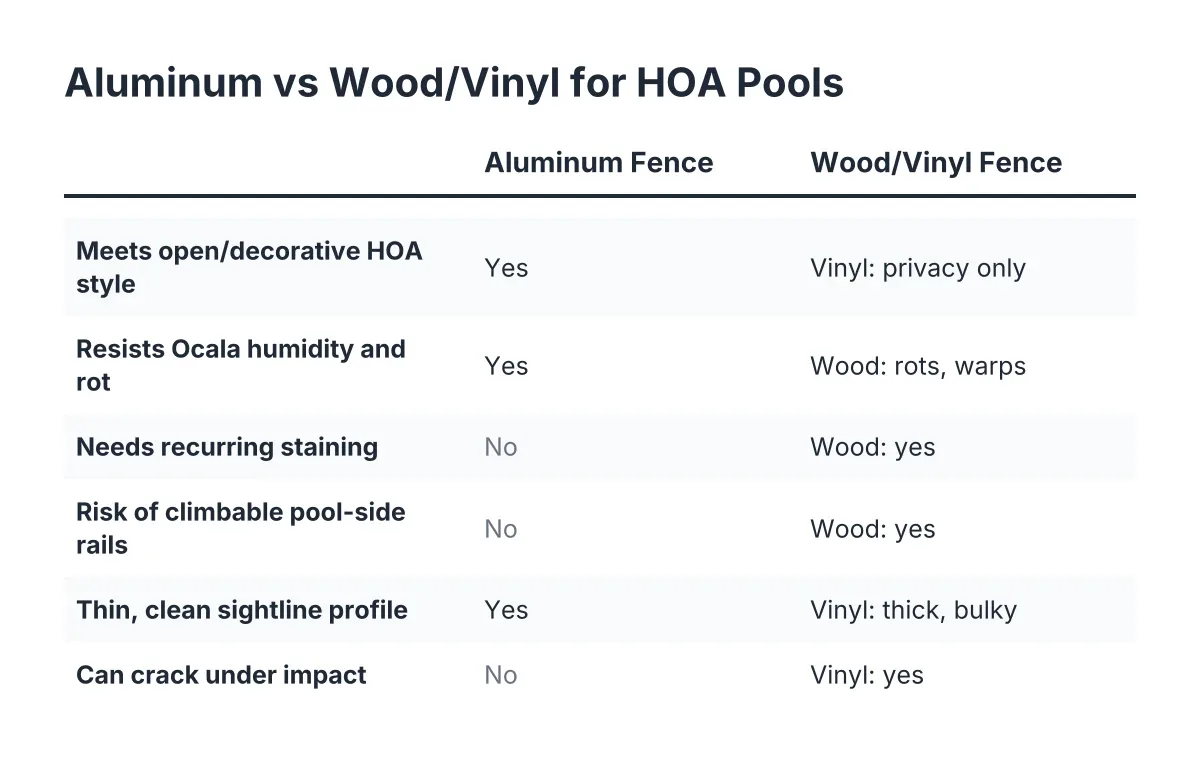
The first is maintenance that never ends. Ocala's humidity and rain are hard on wood. Posts warp, rot, and twist over time. Staining both sides of a wood fence extends its life, but that is a recurring chore, not a one-time fix. Skip it and the fence grays, cups, and loosens. An HOA that polices appearance will notice a weathered fence long before you do, and a violation letter about fence condition is the same headache as a letter about fence style.
The second is the pool-code trap that catches wood owners off guard. Many homeowners want the finished picket side of a stockade fence facing into their own yard. With a pool, that layout can fail inspection, because the horizontal rails on the inside give a child a ladder. The climbable side has to face away from the pool. So a wood pool fence often forces a choice between the look you want and the inspection you need to pass.
The third is the HOA review itself. Boards know wood degrades. Some restrict it outright near pools or on corner lots. Even where wood is allowed, you may need to commit to a specific stain color and maintenance standard in your application.
Where Vinyl Helps, and Where It Still Loses
A vinyl fence solves the rot problem. It resists fading and decay far better than wood, and it never needs staining. For solid privacy fencing in Ocala, vinyl is often the right call, and plenty of HOAs approve white or tan vinyl without a fight.
However, vinyl has limits that matter to this specific buyer.
Vinyl is mostly a privacy product. If your HOA requires open, decorative fencing, a solid vinyl wall is a non-starter, and vinyl picket styles are fewer and chunkier than their aluminum equivalents. The profile is thick because vinyl needs bulk for strength. On a flat Ocala lot where the board wants clean sightlines, that bulk reads as a wall even in picket form.
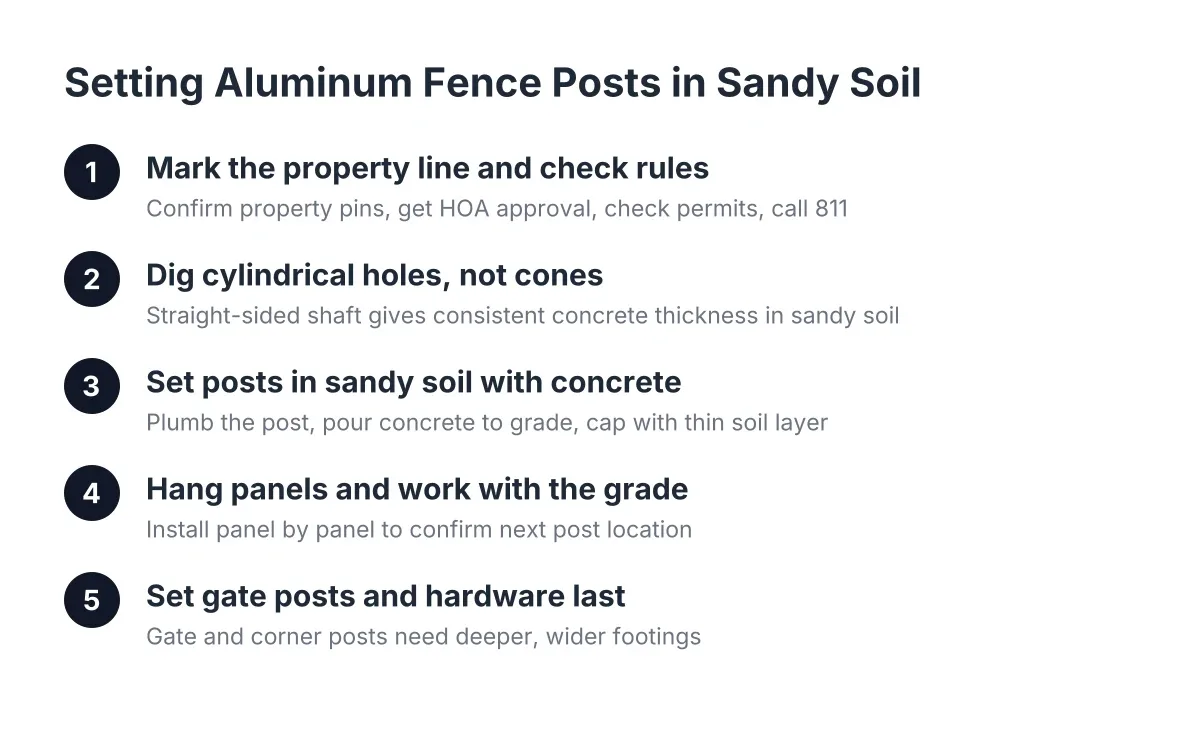
Vinyl also depends heavily on its posts. The posts are the foundation of the whole fence system; the panels only perform as well as the posts holding them. In Ocala's sandy soil, that means post setting has to be done carefully, and tricky spots, like butting against a neighbor's fence or working around a tree, sometimes call for a reinforced post with a metal pipe sleeved inside the vinyl. Done right, this is fine. Done cheaply, it is where vinyl fences start to lean.
And vinyl is still PVC. It will not rot, but it can crack under a hard impact, and in extreme conditions like a wildfire it can burn. For most Ocala yards that is a footnote, not a dealbreaker, but it is worth knowing.
So the honest summary: vinyl beats wood on maintenance, but it competes in a different lane than aluminum. Vinyl is for privacy. Aluminum is for everything the privacy fence cannot do.
Why Aluminum Fence Works Best for HOA and Pool Households
Homeowners in deed-restricted Ocala communities choose aluminum fence for HOA pools and residential applications over vinyl and wood mainly because aluminum clears all three rulebooks at once. It matches the decorative, open look most HOA standards describe, it meets pool barrier requirements in standard configurations, and it shrugs off the humidity and rain that wear out wood. One material, three problems solved.
Let's take those one at a time.
The HOA Case for Aluminum Fence Meets Pool Code
Open aluminum picket fencing is the style most architectural guidelines are quietly written around. Black ornamental metal fencing, four to five feet tall, with evenly spaced vertical pickets, is the default "approved look" in a large share of gated and deed-restricted communities. When your application shows a fence that matches what the board already pictures, approval gets easier.
Aluminum also photographs well in an application packet. A flat-top or spear-top panel in black or bronze looks intentional and finished from both sides. There is no "good side" and "bad side" like a wood stockade fence, which removes a whole category of neighbor disputes and board questions about which direction the finished face points.
In addition, aluminum holds its approved appearance. Powder-coated aluminum does not need staining, does not rot, and does not rust the way raw steel can in Florida humidity. The fence the board approved in year one still looks like that fence in year ten. For a homeowner whose biggest fear is a violation letter, a material that does not degrade visibly is cheap insurance.
The Pool Safety Case for Aluminum
For pool households, this is where aluminum pulls ahead decisively. Standard aluminum pool fence panels are built to barrier-code geometry: the right height, picket spacing tight enough to stop a small child, and a bottom rail low enough to prevent crawling under. Pairing the panels with a self-closing, self-latching fence gate completes a compliant barrier.
The layout matters as much as the material. According to the Centers for Disease Control and Prevention, a four-sided isolation fence that separates the pool from the house and yard reduces a child's risk of drowning by 83% compared to three-sided property-line fencing. Aluminum is well suited to that four-sided layout because open pickets keep the pool visible from the house, something a solid vinyl or wood enclosure cannot do.
Height alone is not the answer, either. A study reported by the National Institutes of Health found that four-year-old children took a median of just 17 seconds to climb a five-foot fence. What stops climbing is the absence of footholds. A smooth aluminum picket panel offers almost nothing to grip, while a wood fence with exposed horizontal rails is effectively a ladder. This is the detail that decides many pool inspections.
The Ocala Conditions Case for Aluminum
Ocala's sandy, shifting soil is hard on every fence, but it punishes heavy and rot-prone materials most. Aluminum panels are light, which puts less stress on posts as soil moves, and the material itself does not care about rain or humidity. Gate sag, the most common fence repair call in sandy soil, is easier to manage with a light aluminum gate than a heavy wood one.
Aluminum also racks. Most aluminum fence panels can angle to follow gentle grade changes without stepped gaps at the bottom, which matters for pool code, since a gap under the fence is a failure point. On the mostly flat residential lots common in Ocala developments this is a modest advantage, but on lots with any slope it saves custom cutting.
Aluminum Fence Styles an HOA Will Recognize
When homeowners search aluminum fence styles, they are usually choosing among a handful of standard panel designs. Knowing the names helps you write a cleaner architectural review application.
- Flat top. Pickets end flush under a top rail. The most neutral, modern look and the most commonly pre-approved style in newer developments.
- Spear top. Pickets extend above the top rail with pointed finials. Traditional and formal; check your HOA, since some boards restrict exposed points.
- Double top rail. A second rail near the top adds a more finished, estate-style look and extra rigidity.
- Puppy picket or double picket. Extra pickets on the lower portion tighten the spacing. Useful for small dogs and a smart pairing with pool code requirements.
- Smooth top or rainbow arch. Curved or continuous top profiles for a softer decorative line.
Standard colors run black, bronze, and white, with black the near-universal HOA-safe choice. Residential, pool, and commercial grades differ in picket thickness and rail strength, not in look, so a pool-grade panel does not have to look industrial.
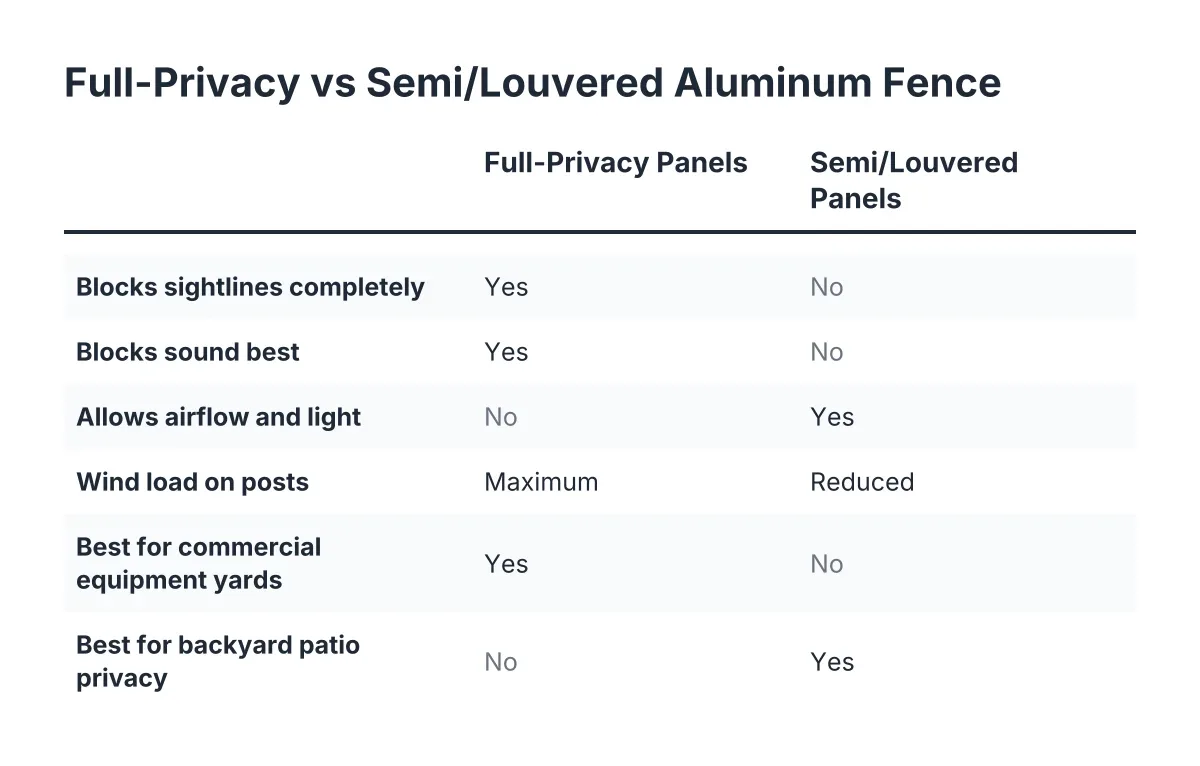
One style question comes up constantly: can aluminum provide privacy? Yes, with trade-offs. An aluminum privacy fence uses vertical infill boards instead of spaced pickets, giving a solid screen with aluminum's durability. It costs more than vinyl privacy fencing because it uses more material. Many pool households split the difference: open aluminum around the pool for visibility and code, and a solid section only where screening a patio or equipment pad actually matters.
What Goes Into the Fence: Panels, Posts, and Parts
Aluminum fencing is a system, and understanding the aluminum fence parts involved helps you compare estimates intelligently.
The core components are panels, posts, and hardware. Panels arrive pre-assembled with pickets and rails. Posts come in several types: end posts, corner posts, line posts, and gate posts, each drilled or built for its position. Gate posts are heavier because they carry the swinging load; in Ocala's sandy soil, skimping on gate posts is the fastest route to a sagging fence gate and an early fence repair call.
Hardware matters more than its price suggests. For a pool fence, the self-closing hinges and the self-latching, lockable latch are what the inspector tests first. Post caps, wall mounts, and brackets round out the parts list. None of these items is expensive on its own, but a quote that is vague about posts and hardware is a quote worth questioning.
This is also where installation quality shows up. The cheapest estimate often reflects shallower post holes, lighter-grade panels, or skipped gate reinforcement, and a fence rebuilt in five years costs more in total than one installed right the first time. Price differences between fence companies usually reflect construction practices and expected longevity, not just markup.
A First-Submission Scenario: Getting the HOA Yes
Suppose a family in a gated Ocala community finishes a new in-ground pool in spring 2026. Their pool builder tells them the final inspection needs a compliant barrier, and their closing paperwork on a refinance adds a deadline. Their first instinct is a six-foot wood privacy fence around the whole backyard.
In that scenario, the architectural review committee pushes back. The community's guidelines cap rear fences at four feet on their lot and require an open, decorative style so the retention pond view stays clear. The wood application gets rejected, costing them three weeks.
Their second submission is a four-foot, flat-top black aluminum fence with puppy pickets on the lower section, a self-closing gate on the house side, and a site plan showing the fence set inside the property line per the survey. That version matches the guideline language almost word for word. It also satisfies the pool barrier inspection, because the panel geometry and gate hardware are built for it. One material, one submission, both approvals.
The lesson is not that aluminum is magic. It is that aluminum happens to match what most Ocala HOA guidelines and Florida pool barrier rules independently ask for, so the same fence clears both reviews.
When You Should Not Choose Aluminum Fence Over Vinyl or Wood
Aluminum is not the answer for every Ocala yard, and pretending otherwise would be bad advice.
If full privacy is the main goal, vinyl usually wins on cost. A solid vinyl fence screens a backyard for less than an aluminum privacy fence, and modern vinyl handles Ocala humidity well. If your HOA allows solid fencing and you have no pool barrier requirement on that fence line, vinyl is the practical pick.
If budget is the only driver and the HOA allows it, a chain link fence remains the least expensive way to enclose a yard, and some pool barriers use it where the mesh size meets code. Many deed-restricted communities prohibit chain link in front or side yards, so check your guidelines first.
If you want a natural look on a rural property with no HOA, wood still has its place, especially board-on-board and shadow box styles. Just budget for staining both sides and periodic fence repair.
Finally, every situation has specifics this guide cannot cover: your community's exact guidelines, your county's permit process, and where your property line actually sits. Before any fence installation, confirm the property line with your survey and get your HOA approval in writing. A fence company familiar with Ocala's soil, permits, and common HOA standards can flag problems before they cost you a rejected application or a torn-out fence.
The Bottom Line for Ocala HOA and Pool Households
Metal fencing is not a niche choice; according to Mordor Intelligence, metal products including steel and aluminum held a 47.2% share of the fencing market in 2025. The reasons Ocala homeowners choose aluminum fence over wood and vinyl come down to alignment. Aluminum's standard look is the look most HOA guidelines describe. Its standard panel geometry is what pool barrier code requires. Its powder-coated finish ignores the rain and humidity that shorten the life of wood.
If your fence has to pass an architectural review, a pool inspection, and twenty Florida summers, aluminum is the material that was built for all three tests at once. Start with your HOA guidelines, match them to a standard panel style, and submit once.
If you need aluminum fence installation, Ocala Fence Builders can help.
Prefer to talk it through? Call (352) 670-3374 — a quick call is usually the fastest way to get a straight answer for your situation.